Saturday, April 11, 2009

Atheism and the Limits of Tolerance in a Free Society - Part 2


"Rendering unto Caesar": The Tax Code and Religion's Special Status

The tolerance shown to all religions in this country is laudable. It is suggest a “big tent” philosophy and generates commerce in the market of ideas. However, the freedoms inherent here are derivatives of the First Amendment. Religion is a speech act as well as an act of assembly. But so is the act of giving any speech on any topic to any assembled group. To be sure, religion plays a significant role in American life and culture, however it is not more special or more protected than, say, rights of the free press, or, for that matter, the right of atheists to hold assemblies in designated buildings. However, over time, religion has received “extra” rights not enjoyed by the other constituents of the First Amendment. Specifically, religious organizations do not have to pay taxes on the profits. Presumably this is because of the automatic assumption that any religion is essentially a non-profit concern. And perhaps there is an argument to be made that individual religious organizations do perform charitable work and should therefore be afforded non-profit status. But could we not also say that a free press performs a service for the community and should therefore be considered a kind of charity? (Especially nowadays, in light of decreased circulation.) What about a political blogger or the local garage band playing at the Kappa Kappa Gamma mixer? The latter two examples may seem to be absurd, but it does suggest ways in which religion has managed to carve a special place for itself beyond its codification within the constitution. We don’t think about the taxation exemption for religion, because the 501c3 status of churches has been with us for so long (1954).


Some American religious leaders have gone so far as to claim that 501c3 is actually unnecessary and that churches in the US are under no obligation to pay taxes in any case. They read the First Amendment’s “free exercise” clause (“Congress shall make no law respecting an establishment of religion, or prohibiting the free exercise thereof.”) meaning that church organization cannot collect taxes from the institution. But this is a willful conflation of the concept of “religion” and the concept of “church.” “Church” is a business concern with real estate, a management structure, and clients. When the collection plate is passed around, the money that is donated is legal tender. Again, it is very probable that the vast majority of church could be construed as chartable. But if the money is going evangelization campaigns and luxuries for the minister it would be a trick of credulity to accept those expenditures as charitable.


This special consideration has emboldened religion, specifically Evangelical Christianity in the US, to seek increasingly larger portions of the franchise. In addition, the strange bedfellowing of the Born Again movement with Goldwater conservatives in the seventies created a powerful and highly successful block within the Republican party. It is a block that would seem foreign and bizarre to the likes of Dewey, Eisenhower, Nixon, and Rockerfeller and an anathema to old time religious zealots who eschewed politics as too worldly. (One should be reminded that Jimmy Carter is Born Again.) Leave it to the actor, Ronald Reagan to take into his vacuous psyche this political chimera and make it a plausible ruling philosophy. Thus we have witnessed thirty years church and state flirtation. While this has meant relatively little in terms of real political change (no prayer in school; abortion is still available, and despite occasional gains in many back waters, Creationism is not taught in public schools), it has created a culture of acceptable, mainstreamed fanaticism. We can see this in the Christian Right’s dubious embrace of Zionism. By purporting to support Israel unconditionally, the far-Right has actually appropriated holocaust guilt to make the claim that they are under attack; that Christianity must be protected against the forces of secularism in America. After all, wasn’t Nazism a secular movement? In casting themselves as the victims of intolerance, the Christian right has attempted to make themselves impervious to criticism. After all, if you are critical of the State of Israel and its treatment of Palestinians, then you are naturally an anti-Semite. And since WE (the Christian Right) believe in Israel’s cause, you are therefore anti-Christian as well. You are intolerant! Assuming underdog status when you are actually in the ascendency is a powerful way of having your rhetorical cake and eating it too.

Wednesday, April 08, 2009

Is this what he meant by "we will listen"?


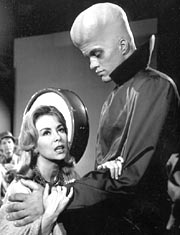
At the end of the famous Twilight Zone episode, “To Serve Man,” the skeptical cryptographer eventually comes to trust the aliens who have thus far desired only to help mankind. After the title of the alien book is deciphered as the hopeful, if ambiguous To Serve Man, Chambers opts to go aboard the alien ship for a holiday. He finds out he is to be just another ingredient in a bowl of human gumbo.


After reading "Government opts for secrecy in wiretap case" I am starting to feel a bit like the fattened calf myself.


I had been skeptical of Obama, and of Democrats in general leading up to the election. I had been a supporter of Edwards until he ran out of steam and subsequently imploded in a sex scandal. Then I became a Clinton backer, mostly because I figured that between her and Obama, her Rolodex would be the more impressive. But then came Iowa, the ultimate underdog victory. I was intrigued. Then there was that epic, and frankly, historic speech on race. I was on the bus then. I took it with him all the way to January 20th. I cried. I felt poetry well up. But I never mistook passion for policy, glibness for governance, or speeches for state-craft. I figured the Obama term, at least initially, would be what candidate Biden had suggest it would be: on the job training.


But over the past seventy-plus days, Obama has surprised many, including myself, which his deftness at international diplomacy, his desire to maintain regular communication with the people, and to treat us like adults, rather than as children needing to be coddled and soothed by happy talk. I think many of us have found his work ethic inspirational. This is a young man at work. We like that, especially in a time of crisis.


And much of this work has consisted of cleaning up after the previous administration’s numerous toxic spills. “Change has come” started to look like an army of bureaucrats with big mops. But in reality, the work was done with ink; filling in the erasures in the constitution wrought by Bush and company; signing the memos and bills that would close illegal detention facilities and bring an end to an illegal war. Those pens seemed to work around the clock, with the Pentagon just recently rescinding a 1991 order, signed by the elder Bush, that denied fallen American soldiers the dignity of being welcomed home by those they have sworn to defend. The pens even went so far as to keep the troll-like Ted Stevens, an obstinate, venial Alaskan Republican senator, out of prison by overturning his conviction because the true interest of justice had not been satisfied. (see related entry below)


All this work has been vital because, with Obama, it seems, (or perhaps I need to put that in the past tense) that principles matter, at least as much as pragmatism.


At least that’s what I had hoped. But as the bloom assuredly withers from the rose, and the warm rush of messianic hope gives way to the icy bite of real politik, somewhere a nine-foot alien is preparing human stew, and we’re all set to join the simmer.


It appears that the Obama administration is not only not going to go after figures in the Bush administration for clearing the use of illegal wire taps against American citizens, it’s also not going rescind the dubious “power,” and still worse, it’s seeking to strengthen and expand the NSA’s ability to spy on citizens by creating automatic immunity for any agent or contractor (like AT&T) who engages in the behavior at the behest of the chief executive. This is especially chilling considering that Obama the law professor used the Bush wiretap powers as a example of the executive branch overstepping its constitutionally mandated limits on power. Bush, of course, had always claimed that all bets were off in a so-called “time of war.” The premise being that the we were actually “at war” (not the president’s place to declare it in any case) against something called terrorism rather than someplace like Nazi Germany or Imperial Japan. Furthermore, candidate Obama continued his critique on the Bush administration by decrying the secrecy and lack of transparency with which the administration had conducted itself post 9/11.


Change has surely come… to Obama’s sense of moral purpose. But what changed? Obama’s desire to undo so much of the Bush program may have caused some trepidation in the Pentagon, a place where Cheney evidently still has eyes and ears. The strange, almost Masonic culture of the place may not have been as overjoyed to see the new boss – the carpetbagger, Leon Panetta – as other departments had been (like State, where Hillary Clinton was greeted like a liberator by her new employees). Obama has no military bona fides to speak of, and has damn few allies in that area. The acceptance of the domestic spying program may be a “cue” to the insiders that Obama is willing to venture a bit into Cheneyian “dark side.”


One hopes for some clarity from the President on this matter, and perhaps a pointed question at the next press conference might talk all of us down a little. But my guess would be that he is hoping that this matter gets buried deep under the present concerns about the economy, North Korea, Iran, and the hot-as-hell “America vs. the Pirates!” action adventure going on in the Indian Ocean this week. It is possible. These issues are not necessarily front-and-center on the minds of pragmatic Americans, especially if housing and food are a genuine concern. Civil liberties, sadly, are often treated as a luxuries during times of crisis, even though that is precisely when they are most needed.

Monday, April 06, 2009

Atheism and the Limits of Tolerance in a Free Society - Part 1


“Not, in any sense… Christian”: The Treaty of Tripoli and our Secularist Founders


Religious folks demand tolerance and, indeed, a free society should require tolerance and enforce laws to protect the free worship of religion. However, many religious people are intolerant of persons they feel violate the religious edicts of their faith. For example, Mormons provided 40% of the funding for Proposition 8 in California. That initiative, which put the right of same sex adult couples to enter into a legally recognized marriage in the state to a vote, passed, thus making a sizable portion of the tax-paying public second-class citizens. The religious people who put this odious initiative on the ballot do so not out of political conviction, but out of religious conviction. Their interpretation of their faith views homosexuality as sin and the marriage between homosexual couples as against their god’s law. Therefore, they do not tolerate gay marriage.


That a religion is intolerant of a human activity is not itself a problem. I do not tolerate engaging in superstations and irrational thought, and it is none of my business if someone else does. Just at it is none of my business if someone wants to take recreational drugs, or vote Republican, or live in a purple house. I read the Bill of Rights as essentially saying “follow your bliss… but leave others alone.” Sadly, the Mormon’s who funded and campaigned for Prop 8 do not feel this way. They do not want to simply live their lives, they also want to control what other people do. So in this instance, intolerance generates legislation and keeps adults from entering into legal contracts with each other.


Likewise, many Muslim Americans rightly feel that they are oppressed by an intolerant majority population, especially since the attacks of 9/11. The sense of siege that many Muslims must feel joins in common-cause with the oppression experienced by the Palestinian population in Israel and those living under exploitive regimes elsewhere. For non-rational people of the Islamic faith, it must seem that they are getting it from all sides, and the same exploitive regimes (Iran, Syria, Pakistan, etc.) that can’t be bothered to sincerely generate a civil society governed by secular laws, are only too happy to distract their citizens and, feigning common feeling, attack Dutch cartoons, Anglo-Indian novelists, and the cinema of Mickey Rourke. This has had the knock-on effect of spurring the sentiments of the worst kind of liberal placatory instincts in the UN and in Canterbury. Not to mention the parallel desire of many school boards to add “balance” to science classes by giving equal time to evolution and creationism so as to not offend the delicate sensibilities of evangelical Christians. It is like a race to see who can dislocate the vertebrae the farthest to bend over backwards for the fanatics. Will it be the boosters of radical Islam, the amen chorus of the pro-Israel lobby, or the apologists for fundamentalist Christianity?


What response is adequate to this? Were it just a matter of public debate, the law need never intervene. But at some point in our history we decided that religion needs to have a “voice” in secular government. The constitution is less explicit about the separation between church and state in Article 6, simply stating that the US would not administer a religious “test” for appointment to office. But unlike the Second Amendment, we do have contemporary commentary which would seem to bolster the separation argument. Take for example these words from the Treaty of Tripoli which ended the conflict between the newly-minted American nation and the Barbary states:

As the Government of the United States of America is not, in any sense, founded on the Christian religion; as it has in itself no character of enmity against the laws, religion, or tranquility, of Mussulmen; and, as the said States never entered into any war, or act of hostility against any Mahometan nation, it is declared by the parties, that no pretext arising from religious opinions, shall ever produce an interruption of the harmony existing between the two countries.

In other words, we are not a Christian nation, and therefore have no beef with Muslim nations. Adding the prepositional not, in any sense suggests that presumably all sects and offshoots of Christianity, including the LDS, would be included in the broader definition of “not [being] founded on.” Our laws are secular laws based on principles of rationalism, utility, and liberty. This is why public schools must not permit prayer and why laws governing state recognition of marriage must not be founded on religious principle. They must not, because they cannot. If we must make appeals to history and heritage, then we should note that our vaunted “Founding Fathers” were products of the Enlightenment, a decidedly secular movement.


One might note this piece of early Federal American prose is a good deal less ambiguous than the Second Amendment. The ambiguity there may be been purposeful in that instance just as the un-ambiguity of the Treaty is here. The wording of the Second Amendment addresses the fluid, changeable nature of national indemnity and culture, whereas the Treaty addresses the immediate nature of the Barbary crisis. If we are looking to read the minds of the Founders, to get at their intentions, then we should look first look at all of the documents of that era (and I would consider the Treaty to be a founding document insofar as it is a product of one of the earliest post-independence crises) and assess what the preponderance of thought was during that time in our history. Between the practical ambiguity of the First Amendment’s “establishment clause” – which, after all, limits religion’s reach in government affairs - and the crystal-clear wording of the Treaty of Tripoli – which tells a foreign nature how they should consider us, the new kids on the diplomatic block, going forward – it should not be a stretch to find a consensus of secularist thought at work in the new nation.


Saturday, April 04, 2009

Hugs! The Obamas in London


By all accounts, President Obama’s trip to the G20 meeting in London has been a success. Of course, all the man had to do is not be George W. Bush. All he had to do is not give the leader of another sovereign nation a backrub on camera or give cute pet names to the Russian leader. In other words, Obama just had to show up. That would be enough to signal to the world that the America everyone used to like has returned.

Of course, there was quite a bit more at stake than the acceptance of the new President by the world economic powerhouses. The twenty nations gathered to discuss the global economic meltdown and what to do about it. Nothing gets leaders to talk serious turkey like the expectation that they are going to fix money problems for their anxious citizens. Human rights, the environment, and war all pale in comparison to the universal desire to get our collective mitts on more of the filthy lucre again. And despite eight years of eroded good will, America remains the hegemonic power on the planet. Though twenty members were present in London, the meeting might well be referred to as G1, with special guests, China ‘n Friends.

Speaking of China, the bratty pissing contest between Sarkozy and China’s president Hu Jintao over tax havens offered Obama an inaugural opportunity to play diplomat-in-chief on Tuesday. Sarkozy has made something of a crusader of himself over the issue of bringing transparency to these dubious entities. He wanted to publish a full report of the havens, an action opposed by Hu Jintao. The row was serious enough for the mercurial Gaul to threaten storming out of the meeting altogether. Obama, playing diplomatic go-between, managed to corner Hu Jintao and Sarkozy long enough to obtain a compromise that made the Chinese president happy and Sarkozy more than a little queer for the new American chief executive, saying to him “you have set a great example for a new and young US leader. This is multilateralism at its very best.” (Of course, Sarko being Sarko had to play up his role and play down Obama’s when he got home - where he is staggeringly unpopular – by claiming victory over “Anglo-Saxon capitalism” and cattily observing that Obama “didn’t know his brief,” i.e. didn’t know the ins and outs of European regulatory minutiae the way he did.)

This, barely a week after word got out that Cheney had referred to Obama as not ready for the “big leagues.” Somewhere in a sleep-deprived Obama brain, the phrase “suck it, Dick” must be ringing like a gentle bell in the President’s head.

Elsewhere, Michelle Obama visited a London girl’s school and gave a heart-felt speech to young, British girls, many of whom represent England’s uneasy multicultural aspirations.

Friends and critics alike are quick to agree that Mrs. Obama is the most inspirational First-Lady since Eleanor Roosevelt. No easy task you undoubtedly feel the pressure to “represent” as the first African-American to fulfill the crucial, yet ceremonial role. She must walk the fine-line between international mother and motivational speaker. Between confident, high achiever and sensitive soul. To this extent, she has a natural antecedent in Hilary Clinton, whose own ambitions led her to rewrite the job description away from being acting as “America’s Hostess” and towards “real” work. But unlike Secretary of State Clinton, Mrs. Obama is expected to look after the very young first family. To this extent, she might envy the patrician sense of entitlement of Jackie Kennedy. But I suspect that there will still be a few school lunches made by the First Lady herself. Again, much African-Americans are expected to go above and beyond adequate. They are expected to excel. It’s a weird sort of liberalism we have here. I can just see a pasty-faced, be-speckled Harvard intellectual saying to a bigot “oh yeah? Well just you wait! My negro will be better than any white man you put up there!”

But I don’t want to sour the nice moment with too cynical an estimation of my people. I think being excellent comes as second nature to the Obamas. They are undoubtedly flawed, but they have never really known privilege. There is a humility and sincerity that is beyond the usual Success Tips of Genghis Khan, Dale Carnegie-style of being good for the sake of an agenda. After all, would the Queen of England have allowed her to touch the Royal Middle Back and then deign to touch her in return where she not somehow authentic in the eyes of Windsor?

Oh, and Sarkozy’s hot wife likes her too!

Wednesday, April 01, 2009

New American Heroism: Sandbags and Justice


Eric Holder came into the Department of Justice after eight years of what can only be termed near-decade of assault on justice. Under the Bush administration, the DOJ was run like some Eastern European communist fiefdom, wherein the agents of justice were used to forward the corrupt, paranoid agendas of herr kommisar Cheney. Under AG’s Ashcroft and Gonzalez, the DOJ was little more than an echo chamber for the crypto-fascistic dogmas of the Bush administration. From Ashcroft’s amen-ing of the scurrilous Patriot Act, with its provisions to tap into the reading habits of Americans by requisitioning library and bookstore records, to the indefensible sophistry that re-defined what torture is and isn’t under Gonzalez (in other words, we don’t torture, therefore if we do it, it isn’t torture), the office of the Attorney General in the United States since 2001 has evolved to look more and more like a tin-pot despot’s choir than an independent protector of the constitution.

I didn’t give much thought to Holder’ appointment. In fact, such has been the damage caused to the DOJ by the Bush-cadre that I rather assume that a degree of entrenchment would stifle any real change for at the near term. After his ill-advised (but accurate) comments about Americans being “cowards” regarding the issue of race in America, I further assumed that Holder may be in possession of a degree of unhealthy narcissism and hubris.

This week, Mr. Holder has done something which, in my eyes, has elevated him to almost Jeffersonian heights. That odious little man, Ted Stevens, Senator from Alaska, had his conviction for making false statements regarding the lavish gifts he had received over the years, overturned by Holder's office. That Stevens is a greedy, petty little jerk is without question. Is the sort of guy you like to see IT stuck TO. But Holder’s DOJ overturned the Steven’s conviction. Why? Because HIS men, the prosecutors, turned out to be bigger scum bags than Stevens by withholding exculpatory evidence from the defense. In other words, the fix was in.

Holder probably could have let the conviction stand. Ignore it. Let it get sorted out on appeal. By instead he stepped in, embarrassed his people, and did the right thing. Will Stevens and company crow? Will he be pitched as the little old man who got pounced on by the big bad guv’ment? Probably. But that doesn’t matter. What Holder has done by overturning the conviction is to draw a line under the Ashcroft/Gonzalez years. He has put “justice” back to the department.

-

North Dakota came close to experiencing a junior version of Katrina-style catastrophe this past week. Citizens of the Red River Valley, young and old, black and white, volunteered hours and days to sandbag a 15 mile section of their town in the hopes that they could avert the worst ravages of the flooding. Flooding has been the bane of the RRV for as longs as folks have lived there. They were ready this year for 41 feet of water. They got 40.82. Less than a quarter of inch of water made the difference between the town continuing to exist and it becoming a cold Atlantis. But it wasn’t just inches that matter on the outskirts of Fargo, it’s muscle. While there are many stories of self-organizing and fitness-to-purpose, the March 26 tale of two busloads of school kids from the Pine-River Backus school turned out to fill and stack bags to make sure that a 92 year old woman’s home would be protected from the flooding. According to the near-centenarian, she looked out the window that morning and saw “angels coming.”

And why did they do it? Guilt? Fear? Was there a merit badge in the offing? According to one tenth grader, the answer is fairly uncomplicated: “It felt really good to help people.”

Tuesday, March 31, 2009

Crossovers and the Sandbox


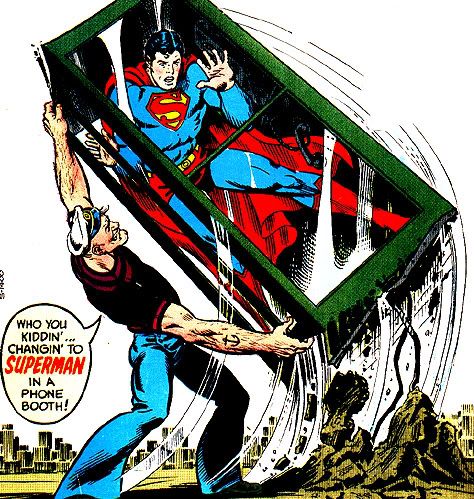
NOTE: This bit of blogging began as an email to a friend about inter-company crossovers in the comic universes of DC and Marvel. The discussion also included the related topic of the convoluted, universe-changing story arcs that both companies seem to like to put on from time to time. This is pure-geek territory and I would probably not include it on the blog, but I do discuss the nature of crossovers in terms of copyright issues and notion of the "sandbox," a free-play area where ideas can mingle without it being a "big deal." So the thoughts are pretty random and perhaps disorganized but I think they are a good starting place for a broader conversation about legitimate concerns for intellectual property and the right of creative people to mix-and-match cultural signs and signifiers a la mash-up culture. Indeed, Alan Moore's League of Extraordinary Gentlemen is most certainly a sandbox creation that is immune to the vagaries of a too-punitive copyright law only because the characters involved (Allan Quartermane, Mina Murray, Captain Nemo, the Invisible Man, etc.) are in the public domain. But what if one wanted to team James Bond with the Six Million Dollar Man? Or have Lara Croft meet Indiana Jones after she stumbles into a Tardis? Those crossovers would have to be preciptated by months if not years of negotionations with lawyers and accounts. The final agreement, if one were to ever be reached, would be anondyne, like the awful Alien vs. Predator film franchise. This short essay comes from a child's head-space, ultimately. It comes from a serious jones for "what if" ; a kiddie-hood of waiting for the annual Justice League/Justice Society team up from DC, and frantically scribbling away on drawing tablets trying to get Batman to punch Darth Vader. And, of course, it finds it's origins in the ancient debate between who-could-beat whom... could Superman lick Tarzan? Is Popeye stronger than Captain Marvel? Are the Lone Ranger and Zorro friends? Before I get to the article itself, I will leave you with this bit of wisdom from Mr. Moore:
"The planet of the imagination is as old as we are. It has been humanity's constant companion with all of its fictional locations, like Mount Olympus and the gods, and since we first came down from the trees, basically. It seems very important, otherwise, we wouldn't have it."
--------------------------------------------------------------------------------------------------

The word that comes to mind when I think about DC and Marvel attempting these big arcs that promote inducements to purchase titles a collector would not normally purchase is "anodyne." Vision gets lost when one person brings it to a table with 20 other guys. The committee has to decide between:


1) doing nothing because the vision of one person is pure and no one else can agree whether the continuity to should be altered in a certain direction;


2) doing something that takes into account about 1% of everyone's "stake" in the plan;


Obviously, when you do #2... it's just shit! Watered down, compromised, and the vision is totally lost.

Secret Wars was a terrible series but I don't think the Marvel folks wanted to do much more than make toy profits. I actually thought Contest of Champions was a more interesting project. Squadron Supreme (though the writing was terrible) was an example of true vision because it was under the radar. Gruenwald couldn't do a JLA storyline and The Avengers was not on offer so he used these forth-and-fifth string heroes from a different non-mainline continuity to play in his sandbox and explore the various things that can happen when power if given to and taken by super humans.


Crisis on Infinite Earths, perhaps the most ambitious crossover project in comic's history, was an attempt to create a DCU for the next fifty years (well, from 1985 onward). DC has purchased all these different comic book universes (Fawcett, Charlton, etc.) and had to integrate them into their already complicated multiverse of duplicate continuities (two of each major hero... overlapping origins... I mean, Hawkman's story is out of control!).


The multiple Earth's concept (I felt/feel) worked because it allowed for variations on a theme. You had aging and even dying superheros (Batman), heroes who could live alternate lives in variance to their "mainline" (i.e. "Earth 1") counterpart, and options for occasional crossovers (the annual JLA/JSA teams ups). It was sort of a "have your cake and eat it too" scenario.


On a personal level, I adored the idea of mainline heroes meeting legacy heroes - Superman meeting Superman; Alan Scott meeting Hal Jordan; Al Pratt meeting Ray Palmer... and even having competing "legacies" meeting each other - Superman meeting Captain Marvel. It was murky and difficult to keep up with (and harder to explain to outsiders!) but it made for compelling reading. Also, it reflects (I believe) the way life actually is... the patterns are there, but it looks pretty chaotic on the surface.


But Crisis, if anything, was too short, and not altogether respectful of legacy heroes. Superman and Batman are totally forgotten in favor of their bronze age counterparts... the Earths are collapsed into one Earth, thus negating decades of story lines which could have been sorted out better on an ad-hoc basis. I mean... it's a fictional universe... they could have come up with a better solution simply through by letting individual, writers, and artists come up with plot points!


So twenty three years on what do we have? We've seen the advent of Elseworlds which is... the mulitiverse under another name! We've had another Crisis series and at least one major clean-up series (52)... thus recreating the Crisis/Legends paradigm of the late 1980s. Now, the DCU has... another multiverse that is more complex that includes not only the mainline Earth but also the Wildstorm continuity, the Kingdom Come heroes, and even the animated universe.


Why has this gone down? Because it opens up avenues for crossover and merchandising. The Red Son Superman story has generated dozens of statues, posters, action figures... and it is only a matter of time before there is a crossover with the mainline hero.


Maybe in a decade or so DC will blow itself up again. It is the way of things. It's like Hindu mythology... cycles of creation and destruction. It is, after all, a modern, pop cultural mythology.


I believe there should be a space for universal crossovers in the fictional world. A space where copyright is intact but trademark is loosened enough so that creators can mix and match... We've seen DC/Marvel and Aliens/Predator. Star Trek/Star Wars would be a good place to go next. How about Indian Jones vs. Predator? Or how about James Bond meeting Jason Bourne? How about the gang from Lost finding their way to the Lost World? Starfleet vs. The Green Lantern Corp? Darth Vader makes an Alliance with The Cylons? A lot of this already happens in fan-fiction. It doesn't dilute the characters at all. Batman has been involved in so many crossover scenarios (Dracula... Predator... Punisher) that it's hard to keep track. It doesn't affect the mainline continuity . Batman can kill Superman but that won't affect them teaming up to form yet-another incarnation of the Justice League. Wonder Woman can have that lesbian affair with Seven-of-Nine... why not? A Golden Age Spider-Man (webgun... suction cups... is a teen detective) run afowl of The Bat-Man when his case takes from New York City to Gotham...

Of course, if the artists/creator owns the work (rather than these semi-public domain icons like Superman, Spiderman) than that should be respected... but at some point, a character grows up and leaves the nest. Siegel and Schuster's Superman didn't fly! Fortunately, he's developed over the decades...been powered and de-powered over and over again... Composers write the music and the musicians play variations... they do "covers," they play in the sandbox!


------------------------------------------------------------------------------------------------