Showing posts with label obama. Show all posts

Friday, August 21, 2009

Health Care, Racism, and the New American Misanthropy

A South politician preaches to the poor white man,
"You got more than the blacks, don't complain.
You're better than them, you been born with white skin," they explain.
And the Negro's name
Is used it is plain
For the politician's gain
As he rises to fame
And the poor white remains
On the caboose of the train
But it ain't him to blame
He's only a pawn in their game

- “Only a Pawn in Their Game”

Bob Dylan

A certain segment of the population want to believe the conspiracies about Obama because it allows them an “out” for their otherwise blatant racism. They hate the concept of an African-American president. They might be able to swallow the concept of a black Republican president because they might feel that the real power is in the hands of a sensible white man like Dick Cheney. But a black Democrat is the worst of all possible worlds. Not only are they inferior to good, Christian, northern-European descended wealthy heterosexual men over thirty (did I leave an adjective out?), but as a black man, be MUST want to seek vengeance for slavery, Jim Crow, lynching, Tuskegee experiments, segregation, Martin Luther King Jr., Malcolm X, Medgar Evers, and Rodney King. So obviously whitey is going to be a touch jumpy, no?

But racism is bad. You learned that in school. In any case, it’s not acceptable anymore to express prejudices in public like mom, dad, and grandpa use to around the house. It will be our little secret. You still have those feelings, though, don’t you? Oooh! You want to say the word so badly!

On the other hand, being that Obama is a Democrat, he can be saddled with all manner of slander and assumptions associated with Democrats since the Reagan era. It was during that time that the otherwise innocuous descriptor “liberal” became a slur, and “government program” became “socialism.” Socialism itself is not really very well understood by either party. The brain trusts who go into politics are seldom from political science or history backgrounds. There is some vague memory of the Soviet Union and how bad those guys were and we have some idea that they were socialists because it was in their name. (Although, the Soviet puppet state of East Germany was a Democratic Republic, even if only on paper.)


Socialism means something different to the belligerent yahoos who show up at the anti-Obama rallies that are disguised as anti-tax fetes and town hall meetings. It means a kind of broader community sensibility, a distribution of franchise, and maybe some obligation to one’s fellow citizen. But many Americans hate each other. They tolerate each other, sure. Most of the time they are ok with whatever Jones is doing because Jones lives in another city or state. But if we find out that Jones is gay and wants to marry, we are extremely annoyed because they are being forced to have an opinion on a lifestyle we don’t approve of. Politicians swoop in and say “hey, guess what, yahoo, you know that fag you hate, Jones? The one who lives nowhere near you and pays his taxes? Well, he wants to get hitched. I know! Yes, the world is coming to hell in a hand-basket. But you can do something about it! On the ballot this November is a little proposition…” and so it goes.

But as easy as it is to locate homophobia, xenophobia, misogyny and racism in America life, I think to label these occurrences thus misses the broader trend. Because the homophobe also hates Blacks, Mexicans, Jews (if he is aware they are Jews), hippies, women, people who attended a different college than they did, people who live on the other coast, postal workers, drive-thru cashiers, mini-mart operators, teenagers, and the elderly. In short, he simply hates. The word for this type of person is not in common use so much anymore – misanthrope. We don’t use it much because it is a funny word, faintly French, and when it is used, it is usually seen as an innocuous, even endearing term for one who is simply cantankerous. Kurt Vonnegut described himself thus. I suppose Holden Caulfield, too. Linus is famous for saying “I love humanity, it’s the people I can’t stand.” But I think some distinction needs to be made about a kind of frustration with humanity’s failings and the sort of need-down resentment that many people feel that there are so many people about.

This isn’t to diminish the very real phenomena of specific acts against a specific group. I would only suggest that someone who hates African-Americans probably hates gays, too. A brief reminiscence: Some years ago catching an American Nazi Party “chat show” on a local cable access channel. (It was pretty vile but also fascinating because they had a potted plant in the background, just like a any other chat show.) At the end of the program an address flashed on the screen to write to the local sponsor of the broadcast. I quickly jotted down a few words of criticisms, suggesting that white supremacist could never really be truly happy because once they got their Aryan paradise in the Pacific Northwest, they soon discover reasons to hate Baptists, or Lutherans, or redheads, because what they hated was not so other races, but just other people in general. Once the specialness of the “clique” no longer gained them fellowship (there is no in-group if there is no ”other”) they would grow discontented and seek scapegoats to explain their angst or personal failures. I sent the missive off and much to my surprise, I received a very quick response. (He was probably surprised to get a reasoned critique in the mail rather than dog shit in an envelope.) He carefully explained that all white nationalists would move to the new Aryan homeland and live in confederated union, with various “clans” living independently of one another. Thus, Lutherans would get say, Seattle, while Baptists would get Salem. He explained this like it made all the sense in the world, as if he himself couldn’t see the deeper distrust at work here: white supremacist don’t like other white supremacists! It’s not that they are intolerant of other races, it’s that they are intolerant, full-stop.

This misanthrope I am describing is not, however, on a binary switch. It’s not as if between Clinton and Obama the racists and the anti-liberals were happy and carefree. I’m sure they were the same miserable, sulky, intolerant skin-sacks they always were. But even if Bush was rather a shade too liberal (believe it or not!) for these folks, there is a thought that, at least nominally, Bush (and Bush the First, and Regan, etc.) is “one of us.” When the Republicans talk about their “base,” they aren’t talking about the agents of capital, they are talking about these paranoid crypto-Birchers. Another factor playing into this is the comfort that these people find in all manner of conspiracy (it is a good substitute for education. Just make up reality.). In this case, they are comforted by the notion that although the Republicans are a part of “The Beast” known as the Federal government, they know that there are secret meetings going on to plot out some sort of End-time scenario. They know this because they can read between the lines when Regan talks about an “Evil Empire” or when W. Bush refers to America’s war in Iraq as a “Crusade.” They are speaking directly to them!

The only solace I take in all of this is knowing that the vast majority of Americans are like this. They may be annoyed, and even hateful of their neighbors. But most do not go down the road of conspiracy. The elements of paranoia and reality invention conspire to turn simple misanthropy into full-blown terrorism. What is terrifying is that the agents of capital – I am thinking of the health insurance lobby at present – have managed to organize the yahoos like a children’s crusade against Obama, ostensibly because he wants to bring socialism to the United States. But what has been organized is perhaps more than what the insurance companies had bargained for they will have to take on the liability of bringing into the debate extremely disturbed and disturbing individuals who are not above characterizing the president as a Nazi or brining assault weapons to public events.

Friday, June 05, 2009

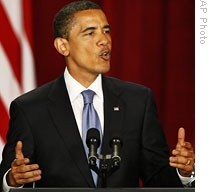
Obama in Cairo: The power of knowing your audience


Obama’s Cairo university speech may not go down in history as one of the “great” foreign audience speeches a la Kennedy’ “ich bein eine Berliner,” or Reagan’s “tear down this wall.” In both of those speeches, the President of the United States was speaking to allies about enemies. Back then, the enemy was a government, an economic system, and political philosophy. Communism was what terrorism isn’t. It was a bureaucracy; a machine for oppression and tedium like the world had never seen. A joyless, anti-human, pig-headed method for organizing the absolute worst in the human psyche and channeling it into a belligerent mediocrity whose singular achievement was to make half the world fear them while making the other half go bankrupt.

But Obama’s task in Cairo required much more of a tightrope walk than either Kennedy or Reagan had to endure. America in Kennedy and Reagan’s time was much beloved the world over. We were the “good guys,” and we possessed a lifestyle and standard of living envied from Ankara to Zambia. For sure there dirty, criminal CIA schemes, political intrigue and the undermining of democracies in favor of friendly dictators, but these were the talking points of a liberal intellectuals and they had little play in the global public. News, even in the Regan 80s, took time to filter down through to the rank and file. And once those words reached the public’s consciousness, then tended to have a longer “mulling over” time; more time in the public sphere. But Obama, living and function in the 24 hour news cycle, gives a speech that is filtered, processed, quantified, assessed, and contextualized, within hours rather than days or weeks. The speech can be watched on youtube (along with Kennedy and Regan’s speeches), emailed, converted into an mp3 and parodied with a turnaround time that is all the more staggering in it is done without a discernable commercial interest. (Sort of like a blog!)

The president’s speech, though not one that is likely to quoted or included on a highlight reel, is perhaps more important than either of his two predecessors. His immediate audience want to like him as “Barack Obama: Superstar.” They love the celebrity, the charisma, and the symbolism of his presence. But as American president, feelings probably range from cynical dismissal, to outright resentment of the policies he is perceived as representing. A word that kept coming up in the Arab analysis of the speech is that America is seen as the chief source of all Arab humiliations since the beginning of the previous century. To be made humble is (at least according to the Arab pundits and journalists who spoke on the subject) is among the worst sins that could be committed against a person. Humility itself, however, is considered a high virtue in the Arab world. It suggests an acknowledgment of human frailty and fallibility. Thus, when Obama, in a stunning reversal of unspoken policy, admitted to America’s participation in the overthrow of the democratically-elected Mosaddeq, what Obama was really saying to Iran there are roots to this tension between our two nations, and here’s what I will own. Likewise, when the president rightly characterized the Iraq Was as “a war of choice,” he was admitting not so much to error, but to a reality that he acknowledges has caused havoc in the region.

Other signifying moments during the speech was Obama’s judicious use of quotations from the Koran. With the exception of Thomas Jefferson, Barack Obama may be the only president to take Islam seriously enough to study it and know what he is talking about. Obama found the most ecumenical , if not the most humanist, passages from that often shockingly obscure tome and used them to build a case for common ground. Here, that which was a liability during the campaign became a positive boon as only a man named Barack Hussein Obama, with his dark, not 100% African complexion, could plausibly say these words and somehow make them not sound trite or pandering. These were the sugared-spoonfuls that often bookended the more potent medicine of America’s standing by Israel, defending herself, and going after the co-religionists of the audience.

What this speech also does is affirm Obama’s willingness to treat his audience as adults. The Cairo speech is chapter in an ongoing discourse on the hard issues that began with candidate Obama’s speech on race, to his sober election night acceptance speech, and his recent commencement speech on abortion at Notre Dame. Obama is unwilling to ignore the hard topics, and he is not interested in shying away from controversy in favor of happy talk. It is possible that his charisma and symbolism are so self-evident that can carry him through these awkward and often intractable issues. His awareness of this aspect of his personality may allow him to some extent, forget about them, and simply read his speech and let the words do their job. Whether or not this is a sustainable strategy remains to be seen. Reagan managed it for eight years. Clinton’s own capacities turned to a kind of smarmy glibness towards the end. The people, here and abroad, may tire of this man of charm and equanimity before his policies are in place. But given the ability of the president and his administration to anticipate these angles and to think non-linearly, I would tend to think that there is even a speech on that dicey subject being written as we speak .

Wednesday, April 22, 2009

Tortured Logic II : Truth or justice? A possible way forward.

The Obama administration is losing control of the torture narrative, and there is a real possibility that the right may hijack this issue using classic Rovian playbook tactics. The half-measures and equivocation that have led up to this moment – the tepid, measure language of post-election Obama on the topic of prosecution combined with the preemptive pardoning of CIA agents who engaged in torture - has created a space for plausible deniability on the part of Bush administration, and generated an opportunity for legal limbo which will obscure the central thesis. Worse, recent discussions in the legitimate media have fed into neo-con talking point about “successful” water boardings, which in turn has revived that vile, Bush-era euphemism, “enhanced interrogation.”

The ghosts of the Bush years, chiefly Rove and Cheney, have kept the business of misinformation and Rumsfeldian word play going during their various soundings on Fox news and at various fund raisers. A week of attempting to distract the mainstream media with bogus, “tea-parties” (a motley assortment of heart-sickened Ron Paulists, anti-tax libertarian conspiracists, sore losers, and - distressingly – racists) utterly failed to derail legitimate talk of possible glimmers of hope on the economic horizon. The parties also failed to keep the release of the “torture memos” from making front page news. (It must be devastating to have lost complete control of the program.) But just as the possibility of having the past eight years of executive and judicial criminality brought out of the darkness was seeming like a reality, Obama opts to give the perpetrators of torture a pass. This is a transparently political move to gain favor with the Pentagon. Obama needs them on his side. He erred in selecting an outsider like Panetta to run things on that end. Now he wants to gain allegiances from those who may feel more kinship with the former vice president than the current young man in the White House. But always desiring to have and to eat his cake, Obama has made some gestures towards justice by suggesting, in a rather meager way, that those who actually gave legal direction and sanctioned torture may have to be prosecuted. According to recent reports, the top two names on the list are former Secretary of State Rice and Cheney.

(Now that they can no longer say they weren’t involved, Cheney and company must try to reframe the issue. No longer will they deny that it is torture, but they will say it was effective torture. This “evolution” of the Bush administration’s talking points on torture is distressingly similar to the pattern used to justify the invasion of Iraq: First it was to stop Saddam’s WMDs, then it was to fight terror, then it was a war for Iraqi freedom. )

Again, Obama is looking to please and be pleased. This is not a novel position for Obama. When he was the candidate for Illinois state senator he would race between the Methodist church and the local chamber of commerce, hoping not to mix up his speeches, the President had to keep many people happy, and if not happy, at least on his side, and if not on his side then, minimally, not totally against him. This is probably politics at its best and may make people like Chris Matthews salivate, but to a citizen concerned with justice, and interested in seeing bad men brought down, humiliated, and finally broken on the engines of our democratic ideals, these gestures smack of rudderless pragmatism.

But taking a step back (or down, as in, “talk me down!”) there might be a way for those who are interested in seeing Cheney, et al answer for their crimes to meet Obama and AG Holder half way. The compromise might be truth rather than justice. It might involve knowing what really happened in our name rather than having our fondest wishes realized (in my case, Cheney bunking with Rove in a Federal prison cell). As I mentioned in an earlier entry, truth and reconciliation, as practiced in South Africa, may be a way forward for us as a country. People interested in justice may have to accept that power, money, and influence often trump concerns for due process and a final accounting. After all, Henry Kissinger is still at large, despite the protestations of Chris Hitchens. But the truth does matter. And there are people who worked in the Satanic bursaries of Rice and Cheney. There are CIA agents dying to light candles and tell their stories of orders to torture and their subsequent haunted dreams of no small distress. Such a drawing together of the supporting cast would generate a catharsis which may heal places where mere prosecution (with all of its tendencies to mask truth behind ambiguity. Think how Bill Clinton parsed grammar to cast the language of sex into doubt.) cannot.

And beyond catharsis, might there be something else? Perhaps such a public airing would finally and forever discredit that amoral, cynical wing of the Republican party we have come to know as the neo-cons, and cast the hulking corpses of the Kirkpatricks and Scoop Jacksons into deserved oblivion, and their acolytes – Wolfowitz, Feith, Kristol, and Perle – into intellectual obscurity. What we’d be left with are Goldwater libertarians like McCain, plutocrats like Romney, dunderheaded populists like Giuliani and Palin, religious zealots like Dobson, and isolationists like Buchanan.

All of whom, I contend, would do less damage to the nation than the Cheney clique have done this past decade.

Saturday, April 18, 2009

Tortured Logic: The ethical double-bind of “just following orders.”


In the wake of the release of the so-called “CIA torture memos” - the memorandum which provided agents in the field with guidelines for interrogation techniques - the Obama administration has decided not to hold CIA agents responsible for acts of torture. Indeed, newly appointed Director of National Intelligence, Dennis Blair, has asserted that his agency “will absolutely defend those who relied on these memos.”


Among other things, this sort of “blame the Generals, not the Privates” defense of illegal behavior smacks of a kind of moral relevancy that should shock anyone who believes that there are imperatives under the social contract. (That is to say, obviously, in a state of nature, there are no laws, therefore nothing is forbidden because there is no social structure to make moral-based choices.) A person placed in a situation where he must decide whether he needs to resort to torture will perform one of three intellectual operations:


  1. Torture because it is valid method to obtain information
  2. Not torture because it is ethically wrong to do so
  3. Torture or not torture based on what orders he is given

Putting aside the nothing that choice four would involve sadists who simply get off on inflicting pain, let’s assume that the above three options are available to a reasoning, sober human being. Only options one and two represent moral postures. An individual may make his choice based on what he feels is in harmony with his world view; the way the world should function. Option three represent a non-choice because it defers the choice to a paternalistic figure who will do the thinking for him. It is not a moral choice but rather an abrogation of our innate ability to function as a self-determining units. It is the position of the masochist, the underling, the henchman, the co-dependent, and the follower. I might also refer to this individuals as cowards, but I think that there may be bravery in certain kinds of faith in authority. I am not totally settled on this matter, so I will leave it for now.


It is possible that at times numbers 1 and 2 will coincide with the orders. That is not an issue of controversy. The question that we come back to again and again in history is what should humans do when they disagree with authority? If the General says “Do not, under any circumstance, use torture” and the agent does so anyway, the agent is listening to some form of higher authority. Jack Bauer on the TV show 24 wants to always be expediting because, well, the clock is ticking. So he will cut through the bureaucracy and get to the information he needs by any means necessary. We might find something admirable in that because we despise bureaucracy and love the forthright man of action. And besides, he’s not torturing good guys.


The conscientious interrogator who refuses to torture even after receiving his orders will face certain consequences. Perhaps he will be viewed as an unpatriotic coward, unwilling to do whatever is necessary in the defense of his nation. (Keeping in mind that there is almost universal agreement among intelligence experts that torture does not work. Famously, the Al-Qaida operative Khalid Sheikh Mohammed gave information after being tortured that resulted in “wild goose chases.”)


The orders themselves may originate from individuals who themselves would not be capable of performing the acts. They may in fact find themselves more in camp 2 or camp 3. But bureaucratic distance allows for the same sort of moral abrogation as when an insurance company denies chemotherapy treatment to a cancer patient. Facelessness is moral detachment. And in the heat of so-called “group think” or the “fog of war” there are ample opportunities for plausible deniability, scapegoating, and euphemism.


As with his refusal to halt the NSA wiretaps, Obama in this matter is showing an ugly form of moral pragmatism that will only serve to undermine his long term goals. Surely, how can we demand human rights from Cuba when we are going to allow agents who torture in our name to carry on with their lives, safe in the shadows? How can we lead with such an obvious abandonment of principle?


What is needed here is a compromise. A truth and reconciliation panel similar to the ones held in post-apartheid South Africa created a space where justice and public confession could meet in common cause. Even upright individuals will hide from accusers if there is the threat of punishment. They will deny their crimes and perhaps become belligerent, seeking hospitality from whatever fringe group will tacitly affirm their behavior. If a CIA agent truly believed that the best option in a torture/don’t torture scenario was to follow orders, he or she must feel a tremendous burden of guilt if they went against their conscious (assuming for the moment that the CIA does not knowing hire sadists). If there is the threat of length imprisonment, they may well be shepherded into the arms of far-right groups like the KKK. But what if the government told them they could come out from the shadows, tell their story, and demonstrate sincere regret without having to lose their lives? What if our government shouldered the blame? What if we went after the order-givers rather than the order-takers?


Wednesday, April 08, 2009

Is this what he meant by "we will listen"?


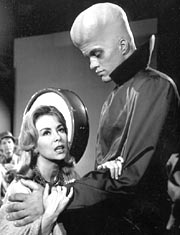
At the end of the famous Twilight Zone episode, “To Serve Man,” the skeptical cryptographer eventually comes to trust the aliens who have thus far desired only to help mankind. After the title of the alien book is deciphered as the hopeful, if ambiguous To Serve Man, Chambers opts to go aboard the alien ship for a holiday. He finds out he is to be just another ingredient in a bowl of human gumbo.


After reading "Government opts for secrecy in wiretap case" I am starting to feel a bit like the fattened calf myself.


I had been skeptical of Obama, and of Democrats in general leading up to the election. I had been a supporter of Edwards until he ran out of steam and subsequently imploded in a sex scandal. Then I became a Clinton backer, mostly because I figured that between her and Obama, her Rolodex would be the more impressive. But then came Iowa, the ultimate underdog victory. I was intrigued. Then there was that epic, and frankly, historic speech on race. I was on the bus then. I took it with him all the way to January 20th. I cried. I felt poetry well up. But I never mistook passion for policy, glibness for governance, or speeches for state-craft. I figured the Obama term, at least initially, would be what candidate Biden had suggest it would be: on the job training.


But over the past seventy-plus days, Obama has surprised many, including myself, which his deftness at international diplomacy, his desire to maintain regular communication with the people, and to treat us like adults, rather than as children needing to be coddled and soothed by happy talk. I think many of us have found his work ethic inspirational. This is a young man at work. We like that, especially in a time of crisis.


And much of this work has consisted of cleaning up after the previous administration’s numerous toxic spills. “Change has come” started to look like an army of bureaucrats with big mops. But in reality, the work was done with ink; filling in the erasures in the constitution wrought by Bush and company; signing the memos and bills that would close illegal detention facilities and bring an end to an illegal war. Those pens seemed to work around the clock, with the Pentagon just recently rescinding a 1991 order, signed by the elder Bush, that denied fallen American soldiers the dignity of being welcomed home by those they have sworn to defend. The pens even went so far as to keep the troll-like Ted Stevens, an obstinate, venial Alaskan Republican senator, out of prison by overturning his conviction because the true interest of justice had not been satisfied. (see related entry below)


All this work has been vital because, with Obama, it seems, (or perhaps I need to put that in the past tense) that principles matter, at least as much as pragmatism.


At least that’s what I had hoped. But as the bloom assuredly withers from the rose, and the warm rush of messianic hope gives way to the icy bite of real politik, somewhere a nine-foot alien is preparing human stew, and we’re all set to join the simmer.


It appears that the Obama administration is not only not going to go after figures in the Bush administration for clearing the use of illegal wire taps against American citizens, it’s also not going rescind the dubious “power,” and still worse, it’s seeking to strengthen and expand the NSA’s ability to spy on citizens by creating automatic immunity for any agent or contractor (like AT&T) who engages in the behavior at the behest of the chief executive. This is especially chilling considering that Obama the law professor used the Bush wiretap powers as a example of the executive branch overstepping its constitutionally mandated limits on power. Bush, of course, had always claimed that all bets were off in a so-called “time of war.” The premise being that the we were actually “at war” (not the president’s place to declare it in any case) against something called terrorism rather than someplace like Nazi Germany or Imperial Japan. Furthermore, candidate Obama continued his critique on the Bush administration by decrying the secrecy and lack of transparency with which the administration had conducted itself post 9/11.


Change has surely come… to Obama’s sense of moral purpose. But what changed? Obama’s desire to undo so much of the Bush program may have caused some trepidation in the Pentagon, a place where Cheney evidently still has eyes and ears. The strange, almost Masonic culture of the place may not have been as overjoyed to see the new boss – the carpetbagger, Leon Panetta – as other departments had been (like State, where Hillary Clinton was greeted like a liberator by her new employees). Obama has no military bona fides to speak of, and has damn few allies in that area. The acceptance of the domestic spying program may be a “cue” to the insiders that Obama is willing to venture a bit into Cheneyian “dark side.”


One hopes for some clarity from the President on this matter, and perhaps a pointed question at the next press conference might talk all of us down a little. But my guess would be that he is hoping that this matter gets buried deep under the present concerns about the economy, North Korea, Iran, and the hot-as-hell “America vs. the Pirates!” action adventure going on in the Indian Ocean this week. It is possible. These issues are not necessarily front-and-center on the minds of pragmatic Americans, especially if housing and food are a genuine concern. Civil liberties, sadly, are often treated as a luxuries during times of crisis, even though that is precisely when they are most needed.