Monday, March 30, 2009

Hamlet: "Play upon me"


Enter one with a recorder

Hamlet: O, the recorder. Let me see. (To Rosencrantz and Guildenstern whom he takes aside) To withdraw with you. Why do you go about to recover the wind of me, as if you could drive me into a toil?

Guildenstern: O my lord, if my duty be too bold, my love is too unmannerly.

Hamlet: I do not well understand that. Will you play upon this pipe?

Guildenstern: My lord, I cannot.

Hamlet: I pray you.

Gildenstern: Believe me, I cannot.

Hamlet: I do beseech you.

Guildenstern: I know no touch of it, my lord.

Hamlet: 'Tis as easy as lying. Govern these ventages with your fingers and thumb, give it breath with your mouth and it will discourse most eloquent music. Look you, these are the stops.

Guildenstern: But these cannot I command to any utterance of harmony. I have not the skill.

Hamlet: Why, look you now, how unworthy a thing you make of me. You would play upon me, you would seem to know my stops, you would pluck out the heart of my mystery,. you would sound me from my lowest note to the top of my compass; and there is much music; excellent voice, in this little organ, yet cannot you make speak. 'Sblood, do you think that I am easier to be played upon than a pipe? Call me what instrument you will, though can fret me, you cannot play upon me.

Here, in act 3 scene 2 Shakespeare commands the extended metaphor into battle against the treachery of a king and the mutiny of friends and in the speaking, effectively destroys the listener with sheer conviction. Hamlet begins simply enough, playing the role of madman for his erstwhile chums. In the wake of his treasonous play indicting his uncle, the king in the murder of Hamlet's father, Rosencrantz and Guildenstern are dispatched by the queen to see out the prince. The engage him seriously with a demand that he visit his mother in her bedchamber. Instead of embracing the matter or even acknowledging the events which have just transpired, Hamlet engages in coy banter. Indeed, this passage leading up to the recorder metaphor is rather light with speech from the prince - R or G will say a piece which is then turned on its ear by a pithy non-sequater:

Guild.: Good my lord, vouchsafe me a word with you.

Hamlet: Sir, a whole history.

Guild.: The King, sir-

Hamlet: Ay, sir, what of him?

Guild.: Is in his retirement marvelous distempered.

Hamlet: With drink, sir?

Guild.: No, my lord, rather with choler.

R&G are not ignorant of Hamlet's jibes, they answer sincerely in order to appear observant of in rank and status. They know full well of his madness for they have, after all, been summoned to Ellsinore at the behest of the queen and have witnessed the shades of this madness earlier in the play. They are handling the prince with kid gloves as they attempt to maneuver him towards their will. They are not surprised by Hamlet's calling for a pipe as this seem precisely the sort of inappropriate, mad behavior they have come to expect. What they are not prepared for is the coming onslaught of metaphor which will utterly dismantle the contrivance of their disloyalty to Hamlet.

This passage is not often spoken about in criticisms I have read on the play. It is a brief passage and is structurally important only insofar as it bridges two of the most important scenes - the play within a play in which Claudius is 'outed' as the killer of Hamlet's father and scene in Gertrude's bedchamber where mother and son verbally duel and Polonius is killed. But I believe that this small, bridging scene is important and noteworthy because the attendant metaphor further sharpens the contrast between the 'mad' Hamlet and the genius who in only pretending to be mad in order to solve the mystery of his father's murder. His brutal lecturing of R&G on their 'playing' of him is also a way in which Hamlet's own ego can register itself. He wants people to see that although he wears the mask of insanity he is actually a cunning and thoughtful manipulator of those around him. He never threatens to give the game away, R&G will continue to think him mad, but there is now a sense, as Polonius says in 2.2 that "Though this be madness, yet there is method in't.

Indeed, Polonius' aside in the earlier scene is eerily prophetic of the later scene in Gertrudes' bedchamber in when Hamlet stabs and kills him. The old man being the only figure in the drama to recognize Hamlet's genius-in-madness is dispatched by the madman himself. Polonius motives for continuing his investigation may be questioned - is he genuinely concerned with courtly harmony? Is he seeking advancement within the court? Does he fear for daughter's chastity in the hands of a mad prince? There is some thought that perhaps Polonius is rather a detective spurred on by his own curiosity. He numerous asides and aphoristic diatribes would seem to indicate that the old man's sense of implicit order has been trumped by the dynamism of the mad prince and that only he, the wizened advisor can get to the bottom of the matter. To this end we note how often he enters into long winded discourse to the annoyance of the king and queen! His unselfconscious waxing on matters philosophic speak volumes to the man's demonstrative ego.

Goo-Goo, Comrade

America as a democracy has worked tirelessly (in a collective manner - the government, the civil service and the private sector) to establish, in the absence of economic certainty, a fully stabilized governing body. If there is such a thing as the American historical memory you can be sure that is scarred by thoughts of the early republic and its desperately inability to maintain cohesion. Then of course, less than a hundred years later, that mythic, romantic catastrophe, the Civil War further plunged the nation into a sort of mass self-doubt. In the decades to follow, and really, this is still such a young nation, through two world wars, an economic depression, and the chronic aches and pains of the so-called 'Car War' the nation and its governmental institutions have solidified into a firm and static status quo. The hunger for true, mass rebellion exists only along the desperate fringes if at all, and protesters who line the streets and boulevards do not call for uprising but for what amounts to progressive tinkering with established laws and methodologies.
However, there is something in the collective psyche - if I can further the politico-metaphysics of earlier- that understands the fundamental difference between the stability and stagnancy, the difference between a calm lake and standing water. Marxist struggle will occur at all levels of a society and at all times, those living under social contract laws require a great deal of the individual 'system' of government and while most are prepared to accept their share of abuse no citizen is without a threshold. But what needs to be understood is that in American in the past century has not required the sort of mass uprising that most Marxist theorists assume is required for change. Indeed, the great changes in America over the course of the 20th century were the result of evolutionary rather than revolutionary methods of political change. Changes in civil right's laws, arguably the most significant accomplishment of domestic American last century, was a struggle carried out over the course of the entire period. It encompassed many sub-movements ranging from the bourgeoisie to the militant and required personalities of matching variety. What is view as the final culmination of the struggle - the years of Martin Luther King's ascendancy, was really the signal of the movement achieving its most important victory - the mainstreaming of the struggle.
These 'baby-Marxist' struggles are perhaps best analogized with the magnitude of earthquakes - they fall along a continuum of degrees and intensities. More often than not, the struggles are much less romantic and earth shaking than civil rights or universal suffrage. Typically the wheres and hows of government workings are the subject of day to day scrutiny. The bellwether for these sorts of changes is the tawdry, pop-culture driven concept of the scandal. Examples are easy enough to list - Teapot Dome, McCarthyism, the secret bombing of Cambodia, Watergate, and more recently, the contested presidential election of 2000. In each case, scandal and controversy brewed and conspired to call into question the accepted methodologies of the status quo - not the status quo itself, mind you but the specific function of a government agent or agency - and from that scandal a process of change would be initiated. That change would either affect the actual operation of that agent or agency (i.e. Nixon resigns from office over Watergate, balloting standards unified after the 2000 election) or it will foster a permanent change in public opinion (the carpet bombing of Cambodia perpetuated the public outcry against American involvement in Vietnam).

Fragments: Trash


It was one thirty in the morning and all the telephone in the city were ringing.

They sat around a cafe table. Talking. Smoking. One of them wasn't talking or smoking but studying for the garbage man's exam (GME). Another one of them looked over at his friend who was in deep concentration and remarked that he saw no future in trash.

Fragments: Mandela


I am dizzy with admiration for Nelson Mandela and his country. What an antidote to cynicism, what a paragon of hope and sincerity. I watched again the PBS documentary and was most moved by scenes of the rugby world cup staged in S. Africa. A game that heretofore had been one of the symbols of oppression had become a rallying point for national unity. Mandela did not co-opt the sport from the whites he joined with it and it with him. Seeing white rugby fans waving the new flag because they felt pride for their nation is very redemptive. One of the narrators said it best - Mandela did not just liberate the blacks he liberated the whites from themselves. He redeemed them, healed them. When this man passes the nation will have lost not its Lincoln but its Christ.

Fragments: Beethoven


Faced with Beethoven it is difficult and perhaps absurd to carry on with one's chosen task understanding full well that anything less than galactic perfection will be a drizzle of urine in the Almighty's whirlwind. Mediocrity creeps in for the likes of half-talents and stays for a spell. Whatever gifts have been bestowed are frittered away by distraction and self-loathing. The insanity that is the 9th Symphony makes one’s body of work seem vulgar and wasteful, as though my life would have been better spent serving the true geniuses coffee and obtaining whores for their pleasure. So why bother at all then? I am not Shakespeare or even Carver. The work I do is on a margin somewhere between slightly entertaining and pretentious. Does anyone need to read another short story about human frailty? Another poem about the rain falling? I do it to keep myself in residence.

Fragments: Bresson


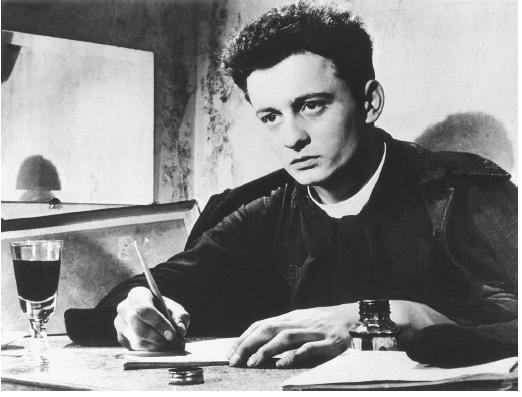
I have been watching movies all my life but prior to seeing Diary of a Country Priest I had never had a conscious cinematic experience. Prior to Country Priest my ideas about cinema were naïve. Thrity or so years of watching, digesting and mentally ranking bang-bang shoot outs, car chases, police procedurals, love scenes and vampires are to me now so much grand guingol, a shadow play of phantasms. Even the best of them, the Kubricks, the Orson Wellses, the Kurosawas, they are ultimately entertainments of various refinements. I've been moved, humored, distracted but I never saw the film as an experience unique to itself. I have always, deep down, felt that movies were an amalgam of arts rather than unified, creative impulse. There were too many things that could get out of hand, to many variables that a single person could not compensate for. Unlike the painter, or the solitary writer, the film maker seemed at the mercy of circumstance. His vision swayed by the passing of time and the demands of pragmatism. I picture him on a raft on a river, being pulled along but never coming to the place he set off for, unless by accident.

Sunday, January 18, 2009

Burris: Hero Plausible, or Hero Passable


In the hours following defamed Illinois Governor Blagojevich’s appointment of Roland Burris as the junior Senator, news organizations and pundits were quick to, on one hand, condemn the appointment while, on the other, not seem like they were beating up on a “decent,” and “honorable” man. I put those words between quotation marks not because I mean them to be read ironically, but rather to underscore how often the pundits used these words. No one wanted to lash out at the appointee, but they still wanted to get their licks in on the "appointer."

A minor, somewhat mediocre circus ensued, culminating in Burris being turned away at the threshold of the Senate for not having the proper credentials – in this case, the signature of the Illinois secretary of state. Between the appointment and the shunning, the media attempted to report on Burris’s career in politics, perhaps hoping to find something of corresponding gravity to keep the Blagojevich orbit of scandal arcing through the firmament. But what came out wasn’t much. Burris is an also-ran, a has-been, a political journeyman. Wikipedia provides highlights of a resume which includes such offices as National Bank Examiner for the Office of the Comptroller of the Currency for the U.S. Treasury Department; Director of the Department of Central Management Service for the State of Illinois, and Attorney General for the State of Illinois, arguably his only blue-chip office.

On the other end of the ledger are the many failed runs at higher office. Unsurprisingly, former Comptrollers seldom possess the charisma and political dynamism to win over the majority of the electorate. Suffice to say, the good people of Illinois said “no” to Burris at every turn. Subsequently, and until his recent infamous promotion, he had seen fit to stick with his consultancy and his go-to-guy work for a major law firm.

So the call to service from Governor Scumbag must have seemed like a mixed blessing. Burris, at 71, is unlikely to ever win a major state-wide or national office on his own merits. To be elevated from private citizen to a seat in arguably the most powerful legislative body in the world must be beyond seductive for a political animal like Burris. The one power which Burris has going into the process - and perhaps the one which compensates for his lack of charisma – is his knowledge of the law. The facts of the matter are thus: Blagojevich has not been impeached. He remains in power. And while in power, he has the right to exercise it. The power to appoint a vacant Senatorial seat is perfectly within his constitutional purview. Burris knew this. He also knew that he himself was clean. (Perhaps one of the perks of being a political loser.)

If he could weather the scorn and the scandal, he would be the junior Senator from Illinois. No asterisk and no footnotes. It might not be a perfect democracy, but we are a country that likes the letter of the law. We can be positively thermostatic about it. We hate to use the excuse that so-and-so won by a “technicality.” We give folks their due and move on. We even got used to the odious 2000 election results. Burris might understand this aspect of American culture. Blagojevich is essentially a hypothetical “Governor X,” someone used in a civics class to represent the person of the chief executive of a state. And in every “what-if” scenario, the Governor retains powers until removed from office. The fact that it may be a fait accompli does not diminish the fact that the constitution of the state does not have a provision for depowering an executive because he or she is suspected of illegal acts.

Through it all, Burris has acted, dare I say, senatorially? His recent occasions in front of microphone bouquets or in the frame of nightly news shows display a man who is on message, determined, and not overly excited. There is no audacity here, simply a man who has ambition, has been given a opportunity to run with it.

Chris Matthews – for whom politics is more spectator sport than tool box - has gone so far as to award Burris something called the “Hardball Award” for being “gutsy” and held him up as an example to children who should “stand up and demand” something that they want - if they believe it is theirs. I am not sure what Matthew’s point is, really. The Burris situation does not have any real parallels in the everyday world. It would be a stretch to claim that Burris had a fire in his belly for the seat. What we do know is that Blagojevich is not a capricious man; there must be something in it for him to move this particular name through the ranks. Given the governor’s shameless race-baiting – demonstrated by his “spontaneous” calling up of the Black-Panther-turned congressman Bobby Rush at his first press conference following the indictment - it is probable that the color of Burris’ skin played as much of a role in his selection as did the content of his character. Thus, in the rhetoric of the corrupted executive he equates his own tribulations with the historic victimization of blacks in America. Nice try. It’s 2009. All bets are off when you’ve got a majority of white Americans – many of whom probably still fear young black men – saying yes to a man named Obama.

Nonetheless, such is politics in our culture that being called to service in government is viewed more as a dodgy career path than a kind of benevolent draft. Politicians are corrupted by money because their jobs actually don’t pay as much as the law partnerships they had to give up. Burris, hopefully, has made enough money in his time that he can accept the position of junior Senator without regard for anything other than a desire to serve. It is important to give people a chance to rise to our highest ideals rather than to assume they will always cow to their basest instincts.

Of course, it doesn’t help that Burris is clearly a narcissist. What else can you say about a man who had “Trailblazer” etched into his massive tombstone along with highlights from his résumé? (Again with the comptrolling!) This narcissism may be a kind of defense against accusations that he is what he is, a political washout. But, again, none of this should matter. In two-years time the people of Illinois will elect a “real” Senator to represent them – presumably the same people who voted FOR Rob Blagojevich, but I digress. In the meantime, Burris will keep the seat tidy (thereby filling in some of the gray-space on his tomb wall) and do his part as an Obama-believer. He may well attempt to run or he may be blown out of the water in the primaries; incumbency under these circumstances is probably not a boon. For Burris, 2009 is simply the year when his luck and his ambition aligned. Would that we could all partake of such fortune.

But I suppose my point here is not merely about Burris’ luck. It is about his guile. There is something very American about not being kowtowed by the mansions of power, especially considering Burris’ anonymity in the national scene until December of 2008. Here was a man who, rather than saying “yes I can,” said “why the hell not?” and “try and stop me!” That he did so with a degree of civility and a lack of the crazies only adds to his ethos, and his plausibility.

Saturday, January 03, 2009

Harley Race: Masochistic Fantasy and Pro Wrestling


At 65, retired professional wrestler Harley Race (6’ 3, 240 pounds) still looks like grandfather-kick ass. His face resembles a plate of steak and eggs with a side of uncooked pork sausage. In his glory years in the 1970s and early 80s, Race wore his mutton chops connected to his moustache, the “commodore” look. Combined with his kinky, widow-peaked hair line, Race just about managed to stand our among the blond muscle men and pretty boys of the era. Race is not pretty. Even when he was “Handsome” Harley Race in the mid-sixties with a shorn kisser and bad bleach job, he still appeared much as he does today – a slightly craggy, slightly blank, slightly gormless bricklayer,

His body has been a remarkably consistent vehicle for him since his debut nearly half-a-century ago. The torso is long, thick, and shaped as though extruded from a large, municipal water pipe. He is not fat, but there is very little in the way of definition. His arms and legs are cardboard tubes tapering into stubs of ham. Harley Race is built for pro-wrestling as though it were a “real” competitive sport. Meaning, if he were to take on real or “shoot” matches, he could stand up to 60 minutes of being beaten about and probably win. (He is a talented “hooker,” although never an amateur athlete.). As it stands, Race’s body is, in some ways, overqualified. Hitting Race with a fist to his midsection must be like punching a water bed filled with sand.

Watching archive matches of his best days, the more intense episodes involve his face getting significantly bloodied. The odd thing, it didn’t seem an unnatural “look” for him. The blood added definition, like a coat of lacquer. His movements, too, suggest a something other than a human being going through the motions of exercise. He was clumpy but also lithe. When he used his big knee on the head of an opponent the feat was performed as if by hydraulics and pulleys; a snap of the tendon against ligament, driven by coiled hunks of farm muscle. The motions were cruel the way threshing machines can be cruel, which is to say that the malice was in the interpretation of the act rather than the intention.

Often Race would be brought forward to fight a man on the other side of the flamboyance scale, often a blond like Ric Flair or Dusty Rhodes. The contrast could not have been more stark. Race’s lack of apparent charisma, when placed alongside the candied radiance of the sons of Gorgeous George (even if Dusty seemed to have a body constructed from white trash bags filled with whipped cream), seemed to transform into something else. An aura of raw, joyless earnestness acted as an inner beacon to call attention to his presence. The average slob might be hard-pressed not to root for Race on some level. He would break the pretty face or tear the gold away from the underserved. A mean, cheating braggart though he may be, Race was that house-cleaning, hell-fire reformation preacher who would make you feel remorse for your sins, in this case, the sin of pride, the sin of glamour represented by the elegantly robed Flair.

Race is that part of American culture that, while admitting to large portion of the arrogance of manifest destiny, abhors anything that smacks of effeminate leisure. Watch a Race promo from the 1980s. The gargling, exasperate Race searches, struggles for, and usually fails to find the correct words. Why? He is not a man of words. Words themselves are products of the same leisure culture that created the hated Flair. In this regard, Race was unusual among the various world champions in the 80s. Consider Flair, Hogan, Bockwinkle, or the painfully uncharismatic champions like Backlund and Gagne, each had a clear, pathos-driven rhetoric which could get at the heart of his character Flair was the classic braggadocio; Hogan, a circus muscle man with some adolescent concept of “cool”; Bockwinkle was the man above it all, the businessman grappler. But Race couldn’t sell those angles. Clearly uncomfortable with a mic in front of him, Race would chew on words, twist and writhe trying to get the sentences to happen. In an industry where the promotional interview is as important as the ring work, Race seemed to have no recourse but to slightly hyper-ventilate or to repeat previous utterances.

A common theme in a Race promo is money. Often his complaints revolved around money being extracted from him, either by the promotion or a wrestler in particular. One particularly amusing promo has Race standing before a suitcase filled with money and his championship belt. He announces that he will give $25,000 to anyone who could end the career of rival Ric Flair. At one point he goes so far as to beg “Would someone take the damn money!” The money aspect may have been a genuine concern. As wrestling was a regional affair prior to the 1990s, Race would have had to spend 200-plus days on the road every year to earn anything resembling the income he (and other champions) bragged about. These were the days before nation-wide exposure and big endorsement contracts provided the professional wrestler with something resembling wealth. Indeed, the working class demographic of the professional wrestling fan is a well known talking point among pop culture analysts. Race’s appeal over the years has to do with the fact that he represents a non-fantasy; a big, strong, hunk muscle, of no discernable shape or form and allied with bad intentions, aimed at the very fantasies represented by the “pretty-boys” and egoists who make up the rosters of most pro wrestling organizations.

Who roots for Harley Race, then? Perhaps no one. He is the perennial heal, but not the kind that fans like. He’s not Roddy Piper or George Steel – essentially assholes and animals. He is a different sort of heel, a guy who would probably prefer to wrestle without so many fans around. It’s not that he has contempt for them (as the conventional heel does) and he isn’t necessarily malicious. Race simply doesn’t seem to play the game this way. And fans both resent and admire this trait. They want to see him beat, but paradoxically, they also like to see him beat others. Why? The dark side of the mirror for any wrestling fan will display that part of the ego which holds himself in contempt; the side that knows they are indulging in an extended fantasy of competition; the side that realizes that the inherent misogyny, racism, homophobia and class exploitation which feeds his fantasies are manufactured by a few businessmen with an eye towards appealing to the lowest common denominator. Harley Race exposed that aspect of their personality and exorcised it nightly in the ring, not for love of the sport, but for want of a kind of Puritan justice. against perceived “soft living” or libertinism. Likewise, his destruction in the ring allowed for the possibility of unrestrained freedom and provided a hedge against inflexible behavior. In short, Race represented a creative space wherein the id and super-ego of the wrestling fan could be negotiated.

Since his hey-day in the 1970s and 80s, Race’s reputation has diminished after a laughable but seemingly necessary period in the WWE (ne: WWF). Race had wrestled a handful of matches for the promotion in the past – notably, a “unification” bout with WWF champion Bob Backlund – but had never fully committed to the ambitious company. Nearing the end of the in-ring career, Race must have considered the WWE the last unconquered territory of his seemingly ubiquitous career . However, the Race story line for the WWE ignored the man’s history and instead fashioned a ludicrous fiction about Race being the “King” of wrestling. Aside from the lack of pedigree (hasn’t Jerry Lawler had claim to the title for thirty years?) the angle simply did not fit Race. Better that he be referred to as “Hellfire” Harley so that he might shame and castigate the new generation of pretty boys and egoists.

Saturday, November 08, 2008

California Goddam! (With apologies to Nina Simone )


Election elation… like a spiritual orgasm or simply a loosening of a long held burden, Tuesday was a night of bliss for anyone who has suffered through these past eight years of treason, mediocrity, veniality, and incompetence. The election of Barack Obama is in every way poignant and meaningful. Symbols matters. Pathos matters. There has been a perceptible shift in public consciousness and the moment will live on as its own entity forever, like a man on the moon.

And like a man on the moon, the moment itself will be of no practical importance save for what it serves as a catalyst for. Four days later is not the time to start registering cynicism. I think I can live off the glow from Tuesday night for at least eleven weeks. And perhaps even eleven weeks and one day further, because seeing Barack Obama sworn in with Michelle and his little girls by his side, I can say to anyone, in any country, that’s MY president. That’s what WE are all about.

But that was a true statement in 2000 and 2004 as well. Symbols matter. We carry darkness in our hearts. George Bush was my president, and for eight years we DID stand for torture, ignorance, war, and, recently, economic degradation due to criminal greed.

This is why, in the midst of the euphoria of seeing a man named Obama win the presidency of the United States of America… I have to look to my own state, and say “California, Goddam!

Goddam you, California for saying YES to bigotry and hatred in the form of Proposition 8!

“Can't you see it
Can't you feel it
It's all in the air
I can't stand the pressure much longer
Somebody say a prayer”

Goddam you, California for looking with love and affection at an African-American man and then spitting in the faces of men and women simply because you cannot accept secular consecrations of same-sex matrimony!

“Lord have mercy on this land of mine
We all gonna get it in due time
I don't belong here
I don't belong there
I've even stopped believing in prayer”

Goddam you, California for putting the comfort of chickens and pigs raised for slaughter above the civil rights of your fellow citizens!

Goddam you, California for running the YES on 8 campaign premised on the fear that parents are too stupid to speak to their children about issues of sexuality!

Goddam you, California for running a cowardly NO on 8 campaign that further stigmatized same-sex marriage by tacitly apologizing for bigotry (“no matter how you feel about marriage…”)!

“You don't have to live next to me
Just give me my equality”

Goddam you, California for being on the front lines of the civil rights marches, student demonstrations, sit-ins, and immigration rallies of the past and not stepping up to help your brothers and sisters in their time of need!

Goddam ME for letting the enthusiasms of the moment distract me from the fight against ignorance and oppression… just because I’m not one of those directly impacted!

This is one of those times I used to wonder about, times in history when individuals and groups were being oppressed. I used to wonder where were the people of conscious? How could this have happened? Where was the courage? Where was the organized outrage? Where was political will?

“I've been there so I know
They keep on saying ‘Go slow!’”

I used to assume that in our enlightened day things would be different. Naturally we would be more rational, more fair, more graceful in our dealings with our fellow citizens. We are California. We have a Republican governor who thinks universal health care is a good idea. We have a Hispanic mayor for one of the largest, most diverse cities in the world. We have a three-tiered higher education system and research facilities that are the envy of world.

We have medical marijuana!

I thought WE were different from those “hick” states that want to ban the teaching of evolution or restrict a woman’s access to health care. I thought we were the “New Frontier,” the zenith of the best of moderate progressivism.

I thought… but I forgot, too. I forgot about Rodney King. I forgot about Japanese internment. I forgot about Armenian exclusion laws. I forgot about Pete Wilson. I forgot about Zoot Suit riots. I forgot about May 1 and Macarthur Park. I forgot about “local’s only” surf Nazis. I forgot about Daryl Gates and choke-holds. I forgot about Rampart. I forgot about Prop. 187 .

I forgot about a lot because you don’t want to remember the stuff that hurts. The stuff that makes you think that maybe we aren’t that good. We aren’t that liberal. We aren’t that civilized.

What hurts is that, this time, I can’t point my finger at the LAPD, or a Republican governor or a big corporation and say “you are to blame!” I can only look at my fellow Californians. I can only look at myself.

We aren’t that good.

Goddam!

Tuesday, November 04, 2008

In case, at some future moment...

... I forget, I put away, the things of the heart
I want some keepsake of the time
when that which was possible
became actual. When the promise
affirmed the better portion
of our nature and said
"Yes, this is who we are
and this is how we will
move forward."

Monday, November 03, 2008

Election 2008: A "Close-Enough" Democracy


Election 2008: A “close enough” democracy


The United States has a rancid method for selecting its chief executive. Two presidential elections are held on the first Tuesday in November every four years… the first is the ceremonial popular vote and the second is the “for real” electoral vote. Only the latter really counts.

Ask 100 Americans what the electoral college is and perhaps 40 of them will even know what the hell you are talking about. Most Americans, even after the elections of 2000, believe that their votes matters when it comes to choosing the President. Even those who feel they understand the electoral system are bound to say that somewhere along the line, their vote does matter because, somewhere along the line, the elector is popularly chosen.

You remember that campaign for elector, don’t you? Gosh, it seemed it would never end… all those negative ads…

Truth to be told, the electoral system is complex by design. Complexity is hard to communicate, which is why the whole subject is glossed over when we discuss democracy in America. We would rather believe the mythology of “one person, one vote,” rather than the more uncomfortable truth that the electoral college is in place to assure the hegemony of the two party system.

We trust you to vote for EVERY office except the most important one, because god-knows what would happen if someone from outside the club got in. Ross Perot… unhinged, perhaps paranoid though he may be, at least knew when he was outgunned. It’s not so much that he couldn’t get the votes in ’92, but that he simply couldn’t win, not without causing a constitutional crisis. Of course, the fact that the electoral college IS a constitutional crisis (in spirit if not in law) is overlooked.

Inertia has taken over. Most of the time the voting public is so doggedly apathetic of Federal politics that it is happy to look the other way. When scandal and catastrophe reach the front pages (as it did in 2000 and as it should have done in 2004) the thought of fundamental problems being at the heart of our democracy creates a kind of aphasia of the political consciousness. We can’t talk about these things because it would mean upsetting the underpinnings of our beliefs about ourselves. It is much easier to look at the “stupid” voters in Florida who couldn’t navigate a ballot, to blame Nader, or the nerd who might cause trouble by acting like a sore loser.

Political stability is not one guarantees of a free society, but at least at the Federal level, it is kind of cult which trumps our revolutionary ideals.


That being said, I am thrilled to go to the polls tomorrow. Here’s a quick rundown of how I am voting. I am including the state-wide ballot initiatives because, though flawed, California’s system of initiative, referendum and recall is a model for the nation. If I were to construct the perfect democracy, initiative, referendum, and recall would join proportional representation, parliamentarianism, election day holiday, and public campaign financing as foundations for that political utopia.

President of the United States
OBAMA - Naturally. Barack Obama has his charms and his drawbacks. But a president is not just a noun, he is an adjective. For eight years, “President of the USA” has been a byword for incompetence, belligerence, and willful ignorance. I believe that Obama has the energy, guile and the necessary narcissism to speak as America, and not simply for America. Symbols are meaningful, but substance counts, too. If Obama is “just” another JFK then little will get done in the next four years (and let’s hope that is the ONLY comparison that will be made with the late president). If he presses genius into service… and by all accounts, he just might… and he can win over detractors the way Regan and Clinton could (and I have my doubts) then things might get done.

But great, good, or indifferent, it is important that the psychic bleeding be stopped. Obama, on a very fundamental level, represents that basic change.

Also, it IS meaningful that Obama is an African-American… and more so that his is mixed. At my core I am a Woody Guthrie, Mark Twain, Studs Terkel (RIP) kind of patriot. I love that I can point to a guy like Obama and say “my President. That’s what WE are all about.”

Congressional Representative
SHERMAN – A nerd. A guy who embarrassed himself on The Colbert Report. The sort of fellow who if you saw him, you might want him to do your taxes (he is a CPA!) but not necessarily run your life. But he is also a progressive in a time when that means something. He cares about human rights. He knows that this Federal takeover of the banks is un-American, and he’s not afraid to go against the party line. Also, he is responsive to his constituents, which, out here could be a college professor or a porn actress.

State Senator
PAVLEY - The Greens (the party to which I, for the moment, affiliate with) are not running very many candidates at the moment. In any case, I do have some affinity for the Democrats at this moment, if only because we find common cause in ridding ourselves of the stinking corpse of the current administration. Fran Paveley is a Dem, which is good enough for me in 2008, but she’s also an environmentalist who gets things done. It helps that she actually knows what she’s talking about as well.

State Assembly
BROWNLEY – A down-the-middle kind of Dem with an interest in education. Essentially “ho-hum” but we have two choices… the Democrat or the Republican. That’s the way it goes in two-party, winner-take-all land. In a proportion system it might be worth-while for a Green or a progressive independent to run but things being what they are… also, I can’t bear NOT to vote.


Judicial
NO VOTE
That being said… so we live in a country where we can’t directly elect a president – an office that the electorate could conceivably study up on, but we are expected to make decisions between ten different judgeships? Who follows these careers? One candidate, Cynthia Loo, has spent time as a “Superior Court Referee.” Another, Steve Simons, has been a “Consumer Rights Advocate.” I can probably come up with a reasonable narrative for these careers, but is this really an office that should be left to a ballot? I have no problem leaving this choice in the hands of a qualified executive… a Mayor, a Governor, a City Council. Isn’t this what we do with the Supreme Court?

State Measures
1A - YES Money for the bullet train linking LA and the Bay Area. It’s about fucking time! They’ve only been talking about it for 30 years. Every governor has turned it down. Never the right time. Meanwhile, England is linked to France by a high speed train UNDER the fucking water! Meanwhile, Japan yawns in apathy over their bullet train. California probably should watch her purse (god, how sexist!) but this is a project that, when completed, will generate a lot of income for the state via tourism and interstate travel. Two hours to San Francisco? Punch my ticket, sweetie!

2 - YES Requires higher standards for animal confinement at farms. Animals raised for our consumption should be treated humanely before they are killed. Scare tactics on the “NO” side focus on racist suggestions of “Mexican” eggs and concerns for increases in cost of food. I doubt anyone will fall for that weak tea. The fact of the matter is that we are completely detached from our food. Maybe we think a chicken is running round free and an occasional egg drops out or that a pig is somehow “caught” while living free and wild on a farm. No. Think trash compactors. Think horrors.

3 - YES Money for children’s hospitals. I support hospitals for sick children.

4 - NO Requires parents to be notified if the daughter seeks an abortion. Abortion is a medical procedure which should be available to all women. Presumably, a daughter with an open, loving relationship with her parents will communicate her heath concerns to them. But, sadly, many parents suck. What if it wasn’t abortion… what if it was a blood transfusion and the parents are religiously opposed to such a procedure? For this reason, Operation Rescue must be disappointed on Tuesday.

5 - NO Changes existing drug offense sentencing rules. Drug laws are absurd. All drug use should be decriminalized. But we don’t live in Fairy-land. There are ways of moderating the draconian legislations in this State, but Prop 5 isn’t it. Good intentions, poorly construed.

6 - NO State money for local law enforcement. The usual “the criminal element is taking over” argument. Police and firemen always need more money. In a different time, a different election, I might say yes to a $965 million allocation to crime fighters. But not in 2008.

7 - YES* We are in an energy crisis. We will not drill our way out, and hybrid and ethanol are dead ends. We need big government. We need mandates. We need FDR. What we get is a sloppily-written piece of potential legislation with more holes than a good emantaller. A lot of good people are on both sides. But California needs to be in the vanguard of the green economy. We can tinker with the details later. But 7 needs to pass. UPDATE: I ended up voting NO at the last minute. I kept seeing the face of T Boone Pickens and remembering how he destroyed John Kerry in 2004. A disgusting human being who is seeking to make loads of dough now that his wells have dried up.

8 - NO Would eliminate the right of same-sex couples to marry in California. This is known as discrimination. Opponents are homophobic and/or simply stupid. No reasonable thinking person can make an argument that two people of the same sex marrying would undermine the legitimacy of so-called “traditional marriage.” Similar arguments were made to keep whites and blacks from marrying not so many years ago. Let’s get over it as a people. Let’s enter the 21st century.

9 - YES Keeps the victim of a crime informed about the machinations of the criminal. Seems common sense. Surprised it isn’t common law.

10 - NO Helps consumers buy alternative fuel vehicles. Good intentions but I fear that it would favor hybrid vehicles. Prop 7 is the more comprehensive plan.

11 - NO Gives a small cabal of power brokers the authority to redraw district lines in the State. Wholly anti-democratic.

12 - YES Gives nearly a billion dollars to veterans to buy homes and farms. It is a pitiful recompense for the lies and, frankly, abuse of the armed services by the exiting administration.

Monday, July 28, 2008

Other People's Toilets - Part 2


Other People's Toilets – Part 2

photo credit: Adam Rompel


I temped for about four years back in the late '90s/early naughts. Much has been written about the topic of temping by better writers than me so I will leave it to them to tell the big narrative.
I worked a couple of six-month stints at the corporate office of a major banking concern. I was pretty anonymous there. I did heavy lifting, loads of filing, and various other menial, degrading tasks that they still saw fit to pay me $15 an hour for (well, the agency paid me $15. I probably cost about $20 an hour to the company.) It was a stiff, joyless place with people well-ensconced in cubicles, and overly serious about bits of paper going this way and that.
My own cubicle was in a wilderness of empty cubicles so I was seldom seen or heard. I did my work efficiently and quickly and always had time to fart around on the Internet and make little sculptures with my office supplies. (I will say that this company has THE BEST office supplies I've ever experienced. I particularly adore the mollusk-shaped tape-corrector device. A true object d'art). By the end of my tenure, my little space was a testament to man's desire to free his bonds of servitude. It was Dilbert meets Fluxus.

Anyway, I only mention this because on my last day of work I merrily went around the building slapping Avery labels on undersides of desks, sides of urinals, on the insides of light fixtures, under the cushions of ergonomic chairs, etc. On these labels I had printed snotty, smart-ass slogans meant to satirize this degrading, soul less workspace. I found a bunch of these labels while cleaning out my home office and am prepared to ditch them in the bin, but some of them still make me giggle. So I figured I'd consign them to blogspace in perpetuity.

In no particular order:
“Ask yourself:'what have I done to piss GOD off?'”

“Cheer up! In a few years... you'll still be doing the same thing!”

“You'd be surprised where they hide cameras nowadays” (NOTE: this one was stuck on the upper-underside of a urinal.)

“REMEMBER: It's not who wins or loses, but where the hell is my fucking coffee?!?!”

“How's that English degree working out for you?”

“DON'T WORRY! In the next life you will make them summer as you have suffered.”

“RIGHT NOW someone is coveting your parking spot.”

“FREE SPANISH LESSONS! Just ask your custodian!” (NOTE: I realize now that that comments is indeed racist, however, at the time I meant it as a commentary on the segregation of labor by race and class. But in retrospect, I wish I would have given this one more thought.)

“Cheer Up! At Lunchtime you can go kill yourself!”

“The boss thinks you're CUTE”

“Office Tip #33: Take your 15 minute break ten minutes before you go home. That way, they'll have to pay you overtime!”

“All temps are ARMED”