Showing posts with label history. Show all posts

Wednesday, May 05, 2010

The MMA Files – Part 3: The Greatest Mixed-Martial Artist of all time is….


Chapter I: (…but first, some history). Generational Evolution.

A professional sport that is in still in its developmental stage like MMA is perhaps too new to have a ranking of “greatest fighter” just yet. We are only now, for example, seeing true mixed martial artists winning matches against what we might refer to as “hybrid fighters.” It is a generational shift. The first generation of UFC combatants were strictly discipline (or lack thereof) representatives. Royce Gracie was the Brazilian Ju-Jitsu fighter. Ken Shamrock was the catch wrestler. Patrick Smith was a kickboxer. David “Tank” Abbott was… well, a brawler. And in between you have savate practitioners, sumo wrestlers, judokas, Greco-roman wrestlers, and the occasional samboiste. Very few, if any of these early fighters demonstrated a range of talents beyond their discipline. A boxer could put a man down with one punch, but if a BJJ expert got a hold of him on the ground, it was all over. Likewise, chancers like Tank Abbott, who actually managed to win the occasional match, would often have the advantage of guile in the face of technically superior opponents.

The original goal of mixed martial arts (in the sense that we know it. There have always been style-versus style events promoted as gimmicks or special exhibitions) was to test style-against-style and settle long-standing arguments. The Gracie family in particular had a vested interest in these early fights because the no-holds barred, bare-knuckle style suited their claim that Brazilian Ju-Jitsu was the most effective martial arts style. Time and again fighters not trained in BJJ would end up dominating the smaller Gracie (usually Royce) initially only to be wind up submitting to a joint lock or by being put to sleep by a choke hold. Because of the open-weight nature of these early bouts, Gracie would often be seen submitting a much larger man, such as Greco-Roman champion Dan Severn, who after keeping Gracie in a compromising position for most the match, ended up being submitted in a triangle choke. The secret seems to the Gracie ability to simply let the other man exhaust his big weapons and allow him to begin to feel overly confident. This in turn would cause him to leave a an opening to the seemingly indefatigable Gracie, who, having conserved amble energy during his “rest” would easily lock his man up in an agonizing pretzel of bone and muscle.


PICTURE: a visual representation of the five micro-generations of professional mixed martial artist. From right to left: Generation 1: Royce Gracie, Don Frye, Ken Shamrock, Mark Coleman, Randy Couture; Generation 2: Fedor, Tito Ortiz, Wanderlai Silva, Antonio Nogueira, CroCop; Generation 3: Chuck Liddell, Dan Henderson, BJ Penn, Matt Hughes, Quintin Jackson; Generation 4: Forrest Griffin, Rashad Evans, Urijah Faber, George St. Pierre, Anderson Silva; Generation 5: Lyoto Machida, Brock Lesnar, Shane Carwin, Brett Rogers, Aldo Reyes, Cain Velasquez


It is with the next, or middle generation of MMA fighters that we begin to see something like hybrid fighting. Mark Coleman, Tito Ortiz, Fedor Emelianenko, Randy Couture, Chuck Liddell, Kevin Randleman, and many, many other fighters who got their start in the late 90s and early 2000s, were capable and comfortable in a variety of positions. A striker like Chuck Liddell could compete on the ground (and more importantly, defend takedowns), and Fedor, arguably the best samboiste in the world, has a record of wins that balances out dynamic submissions and jaw-shattering knockouts. What these fighters were and are capable of doing is switching between styles in-match. The proportional proficiency in any one style may be suspect (Couture rarely tries for submissions; Liddell is better at defending against the ground than dominating the position, and the rap on Fedor is that he can’t box properly) but the ability to turn on a dime and become Greco-Roman one moment, then transition to a judo or BJJ position, depending on the circumstance, is the hallmark of this generation. These now-seasoned fighters grew into the sport from the perspective of developing an arsenal, rather than focusing exclusively on a native discipline.

A key match during this era was the 2006 catch-weight bout between Royce Gracie and then-long-reigning UFC welterweight champion, Matt Hughes. The match was billed as old-school vs. new-school and, in truth, showcased a number of changes in the sport since its debut a decade previous. Hughes, a masterful Greco-roman wrestler, easily took Gracie to the ground and essentially kept him there at will. Hughes kept busy, not letting Gracie really settle into his usual game plan. At one point, Hughes landed a remarkable arm bar, a BJJ signature hold, that probably would have broken Gracie’s arm had Hughes not relinquished it. Hughes then mounted the veteran and ground-and-pounded Gracie to the point where the referee had to intervene and stop the match.

The reason this match is important is not so much for its symbolic value, (“changing of the guard,” and all that) but for the range of techniques Hughes employed to win the match. He transitioned from wrestling, to grappling, and finally to ground strikes effortlessly. The fighters of this middle generation dominated the mid-to-late 2000s and a handful of the first generation have continued to contend as well, adjusting their game and becoming more versatile. (In fact, Hughes recently defeated Royce’s cousin, Renzo, brutally dominating nearly every second of the three-round affair.)

Randy Couture is a prime example of a multi-generational MMA combatant. While still primarily a rather stiff Greco-roman wrestler with a penchant for dirty boxing, over the past several years Couture has added improved strikes and kicks to his game and has even been known to utilize a choke hold. This has been enough for him to collect belts in multiple weight divisions in the UFC. But more on Couture later…

The generation currently coming into its prime in the new decade is the first generation to truly adopt MMA as a specific mode of combat unto itself. The difference between a fighter like Hughes and the new generation’s George St. Pierre is the fluidity of the movements and the integration of techniques without really having to transition between them. Hughes adjusts whereas St. Pierre combines. In other words, St. Pierre is not responding to something that isn’t working by employing a different fighting style for the moment, he is using the momentum of each move to set up the potential for the next one. It is like an ultra complex series of flow charts: If he shoots in for take down, he is thinking of a fork in the road: either my man will go to the ground or he will defend; either way he is going backwards; either way I am moving forward. Looking at GSP’s wins, what is striking is the variety of ways that he has won over the years: punches, elbows, chokes, kimuras, armbars, knees, and a host of judge’s decisions which on their own suggest a strategic dominance as well as an athletic one.

Along with GSP’s athleticism, we may also note a difference in the way the very notion of martial artist has manifested itself in this new generation . Fighters like GSP, Anderson Silva and B.J. Penn almost seem to swim through their matches. Silva especially is adept at making the match seem like dance of violence. If you watch any of his better matches, particularly his destruction of Rich Franklin for the UFC middleweight bet, you will get a sense of a fighter who appears to have choreographed the match from bell to bell. His final flurry against Franklin - a series of body blows followed by a vicious muy thai knee strike to the head which then led to powerful head kick and a final volley of punches - was as close as anyone has ever come to making bodily harm look beautiful. Franklin, a remarkable fighter in his own right, looked positively helpless against Silva. Indeed, their subsequent rematch proved no less convincing of Silva’s powers. He has in fact, seldom looked to be in substantial trouble. His dominance over the second generation of fighters and those in the middle portion of his generation of fighter (such as his rather embarrassingly lack-luster defeat of Patrick Cote, and the strangely one-sided affair against fan favorite, Forrest Griffin) suggests that he is the watermark for excellence in the sport at this time. The question remains whether someone really of his cohort - like GSP or Lyoto Machida – would meet at one another’s weight class. Recent events suggest he may never get that chance, as Silva has devolved in past several matches into unrepentant clowning and showboating.

We might term this era of MMA the “GSP Generation,” to stand just in front of the “Chuck Liddell Generation.” But we might just as easily call this the “Penn Years,” or “The Forrest Griffin Years” or “The Time of Silva,” or even “The Time of Faber.” There are too many claims to be made, all of them justified. Much depends on the legacy these individual fighters leave for themselves as they consider the direction their careers should take going forward. GSP continues to dominate the welterweight division with style, class, and overwhelming athleticism, but there are still dragons to slay and ambitions to fulfill – including a serious desire to join the Canadian Olympic wrestling team in London in 2012. For Penn, the recent loss to upstart Frankie Edgar resulted in an almost immediate scheduling of a rematch. But even if he wins (and the odds are that he very well might) what more is there him to prove at 155? Another run at GSP for the welterweight belt? Silva has talked about retiring from MMA to pursue boxing. And he may indeed be bored. Having never taken a lot of damage, “The Spider” could make a go at light heavyweight. A division he has so far dominated with lopsided wins over James Irvin and Forrest Griffin. But his recent wins have done nothing to improve his standing among fight fans and promoters. Dana White has gone so far as to threaten to place Silva in the undercard, whether he’s champion or not. And speaking of Griffin, the working class hero and baby-faced star of the first season of The Ultimate Fighter , and one-half of the fight that many claim to be THE watershed bout in UFC, if not MMA history when he fought Stephan Bonnar, there are still doubts about his true ambitions in the sport. After a brief tenure as light heavyweight champion, Griffin has gone one-and-three in his recent bouts. A fan favorite, Griffin may be content with his legacy as it stands.

Whoever history smiles on from the post-Liddell generation of fighters, what is clear is that for these men, the book is still being written. For now, we should take the broadest view possible if we are going to locate that elusive “greatest” fighter. So in the next two chapters I will be discussing several fighters who may fulfill the criteria. I will begin with the man who tops most lists… Fedor “The Last Emperor” Emelianenko.

Sunday, April 25, 2010

The MMA Files – Part 2 The Establishment Clause: Professional Boxing vs. Professional MMA


The world of pro boxing is a fairly convenient place to draw up the foundations of an argument for mainstream combat sport recognition. It is long established has a deep history, and a vast cast of characters. What then of a sport just coming into its late adolescence, like Mixed-Martial Arts? As a young sport, MMA is currently in the process of figuring out what it is going to be. Starting out as a freak-show in the hey-day of pay-per view in the early to mid-1990s, MMA grew into a legitimate sport by the turn of the century, thanks to there being serious athletes involved with the events alongside the chancers and circus geeks. Now, seventeen years after its founding, the Ultimate Fighting Championships has helped to establish the sport’s legitimacy, creating something more than a mere-hybrid combat sport. MMA is now a “style” of fighting unto itself. So much so, that traditional martial arts schools and boxing gyms have began to advertise MMA training on their shingles.

The boxing mainstream are not particularly impressed. Floyd Mayweather has famously dissed the sport, going so far as to say that MMA is a “fad,” and veteran boxing journalist and pro wrestling historian, Bert Sugar, also panned MMA as a flash in the pan; a sport fit only for those bored of pro wrestling’s antics. Time will tell, but the box office and sell-through numbers for UFC events don’t lie. Arena sell-outs, record breaking pay-per view events, and consistently high ratings for the UFC’s reality show, The Ultimate Fighter, all speak to the UFC’s commercial legitimacy, at least in the short-term.

That being said, MMA still has some distance to go before anyone forwards it for inclusion as a demo sport in the 2048 Olympiad. It bears repeating that boxing had to jump through a lot of hoops to become legitimate in the eyes of the general public. In its early days, boxing was a lot closer to human cockfighting than MMA ever was. Bare-knuckles, fights-to-the death, and dank basements where the rules of the day before the Queensbury rules of 1867. The 143 years since Queenbury have allowed a space for professional boxing to develop its mainstream legitimacy. MMA, thanks mainly to sanctioning infrastructure developed by and for boxing, has leapfrogged much of this glacial establishment process. It has, in essence, placed itself squarely in the same culture a professional boxing. Las Vegas is the UFC’s headquarters. It’s smaller cards are in casinos rather than arenas. Ring announcers in tuxes and pretty girls carrying round-number cards are the order of the day. Nonetheless, a vocal core of boxing devotees continue to minimize the successes professional MMA has enjoyed over the past decade.

Why is this? There is the usual upstart rap that goes with every new cultural product, especially a new pro sports venture. Truth to be told, they nearly all fail miserably. Indoor soccer leagues, the XFL, arena football, legitimate professional wrestling, these and others have all been tried, and one is wont to not get fooled again. Americans, and perhaps leisure-based cultures in general, are very conservative when it comes to what professional sports they are willing to watch during prime time. Even hockey, once the forth leg of America’s sports table, has fallen back to second tier status. Boxing fans like what they like, and they like the parameters of their culture. MMA is consciously horning in on that cultural space. And, as the UFC’s acquisition of former IBF champion, James Toney suggests, MMA may also threaten to steal away their stars.

Oddly enough, boxing seems to be the only combat sport that feels this need to be defensive. I don’t think we hear a lot from the K1 kickboxers or the Greco-Roman Olympians regarding the legitimacy of the fledgling sport. In fact, at least one MMA promotion, Strikeforce, has felt comfortable blending MMA matches with kickboxing contests on several of their cards. Boxing feels threatened because … well, they have never really had competition. The other combat sports have never caught on in the professional ranks in America the way boxing has. Professional wrestling, boxing’s clownish, cousin, has long since relinquished any claim to legitimacy and has even cut itself off from the genuine historical ties it shares with boxing via their historic tradition of co-promotion. Only MMA has displayed true credentials in the market as a competitor to boxing.. It is obvious that it can make money, therefore, critics must attack MMA as a kind of faddish non-sport. Usually this involves lobbing easy volleys at the fans themselves. They aren’t sports fans but “spectacle” watchers. The kind of people who rubber-neck freeway crash carnage and play ultra-violent video games. Truth to be told, MMA fandom certainly houses such rabble. But then again, are there not hockey fans who primary interest in the sport is the violence rather than skating or stick prowess?

And depending on the location, the venue, and the card in question, an MMA event may attract a lot of these people (made more surly by the access to beer). When televised, their numbers are signified by the rampant booing that can be heard when grappling and wrestling are involved in the match. They want to see punches. They want to see strikes. Frankly, they want to see an old timey boxing match! But these people are not the rank-and-file of MMA fans. They are casual fans, and indeed, probably casual sports fans. Ask any MMA blogger his or her opinion on the topic and you will get an essay on what a “real MMA fan” is all about. It has to do with appreciation of the balance of skills that go into making a well-rounded fighter. Strikes, kicks, take-downs, grappling, “dirty boxing,” transitions, defense, recovery, strategy. They will also talk about “dream” matches and how one fighter is up and coming or down and out or ready to make a comeback. They love the narratives and the drama. Long build up to the big match. The obscure under carder who might one day be someone.

In other words, there is something about passion here, isn’t there? A concern for the display and execution of athletic excellence in the direction of another athlete who may or may not be as prepared, as skilled, or as lucky as the other guy. The passion is something that a lot of “real boxing fans” have or have had for their sport, and it is something this upstart new sport, still in its adolescence, is generating in millions of people around the world.

Thursday, September 17, 2009

What 21st Century Democrats can learn from a 19th Century Republican

In these heady days of ultra partisan bickering, where the side of the good is so clearly indicated by reason, logic, and compassion, while the side of bad is indicated by paranoia, stupidity, and misanthropy, it is worthwhile to locate our moment of history within a continuum of similar contests. If our era’s fight is for health care reform (increasingly being reframed as health insurance reform, unfortunately) then we look to the nineteenth century and a much more fundamental (but no less obviously good) struggle between those who rightly saw slavery as an abomination and those who sought to continue the vile the practice on the grounds of heritage and so-called racial superiority.


Same players, although the poles were reversed. Evil back then was courted and stewarded by those calling themselves Democrats, while Republicans, newly hatched from a crazy-quilt of third parties, Democratic dissenters, and the crumbling remains of the Whigs, clearly saw if not the moral imperative of opposing slavery, at least its unsustainability as a going concern. Then as in now, there was a cloud of unknowing between the two adversaries. There were hints of existential breakdown and whispers of civil war. The cultural differences between the North and the South (surrogated in the proving grounds of what was then known as “the West,” Kansas and Nebraska, particularly) were becoming fodder for a kind of internal xenophobia like a football rivalry writ large.


Into this scene are cast players in a war before the war. Charles Sumner, Senator from Massachusetts, a man by all accounts passionate about the cause of abolition, “a slave’s best friend,” and, also by all accounts, a wholly insufferable man to know personally. Egotistical, pretentious, and (according to an associate) “a specimen of prolonged and morbid juvenility.” In other words, Sumner was an asshole. But an asshole on the side of good. In late August of 1852, he gave a three-hour speech on the floor of the Senate decrying the Fugitive Slave Act, but the once the matter of the Act itself was exhausted, Sumner’s speech because a nasty, crude invective against pro-slavery Senators Stephen Douglas (present during the speech) and Andrew Butler. Sumner went so far as to mock Butler’s speech and mannerisms, both recently impaired by a stroke. Sumner’s speech may well have gone down as one of the lowest, most shameful moments in Senate history had that been the end of it. But what transpired next at the hand of our next player quickly demoted the speech to a distant second place.


Preston Brooks. A little nothing of a Congressman from South Carolina who held to medieval concepts of so-called “chivalry” and always quick to duel (except in one instance, as we shall see) or cop some pose of self-righteousness in a manner familiar to the aristocratic mindset of “old Dixie.” He would have made an excellent, low-ranking Klingon. Brooks got word of Sumner’s speech and wanted satisfaction. The slandered Butler was Brook’s uncle. Rather than calling for Sumner’s censure (which may have ended the still-new Senator’s career. He was not at that time well known or particularly popular) Preston decided that violence was the solution. Ironically, it is Preston’s choice at this moment that made the rather unlikable Sumner a hero in the eyes of the Union. Brooks attacked Sumner, beating him bloody with his thick, heavy, gold-tipped cane. The savagery continued for several minutes while colleagues, helpless to rescue the defenseless Sumner due to the presence of Brook’s goons, could only look on in horror.


Sumner’s injuries were enough to keep him away from the Senate for three years. Headaches, blurred vision, and a severe case of PTSD probably made the man a near basket case. By all accounts, the beating also made him a something of an anti-slavery zealot.


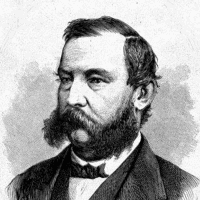
Enter into the scene the third part in this trio of players. One Anson Burlingame, (first picture above) a Congressman also from Massachusetts. Burlingame was a robust New Englander with a serious scholarly mind and a fabulous beard. A non-descript career in the House gave way, in later life, to renown on the international stage as diplomat to the Austrian Empire and China. The Burlingame Treaty is named for him and is perhaps one of the more forward-looking, thoughtful, and fair-minded pieces of diplomatic script written in the 19th century.


Burlingame’s role in the Brooks/Sumner affair is often overlooked by casual readers of history, but it is an important dénouement to the incident. Several days after Brooks beat Sumner nearly to death, Burlingame made what he considered “the most celebrated speech” of his career, wherein he denounced Brooks (on the Senate floor)as "the vilest sort of coward.” Naturally, and predictably, Brooks challenged Burlingame to a duel. And, in one of those historical moments I would personally loved to have eyewitnessed, Burlingame instantly agreed, knowing full-well that as the challenged, he had the right of choice with regards to the weapons used.


Burlingame chose rifles.


Burlingame was a world-class marksman.


Preston Brooks was in deep cotton. He knew it. Although accepting the terms initially, Brooks eventually pulled out of the duel, claiming that he feared being murdered while in route to the Canadian border where the duel was to be held. Well, it was unlikely he would return to South Carolina upright and breathing, although I’m sure safe passage could have been arranged.


In my imagination, I savor the look of clear dismay on Brooks’ face at Burlingame’s enthusiasm for the duel. This, I’m sure was not a typical response and Brooks, like all bullies, cowered at the prospect of confronting true fearlessness. And not just fearlessness, but an almost joyful, relishing confidence. This is what you want from a comeuppance. It is a shining diamond of very basic, deep-body justice. It is not civil and it had no historical significance beyond the moment, but it is one of those tales that could have come from Homer or the Grimms. It has a folk-song spirit to it and one can almost hear the young, Beatniky Dylan hammering away at long verse of The Ballad of Anson Burlingame.


Other than the visceral appeal of a story like this, Burlingame’s example should suggest a way forward for progressives and mainline Democrats in dealing with the current crop of irrational, anti-intellectual paranoids who have essentially filled the vacuum left when the fiscal, Bob Dole style of conservative was rooted out in 2006. The Glenn Beck wing of the conservative movement could not tie Pat Buchanan’s shoes laces, but somehow they are front and center in the media, calling the president a racist, making absurd, tin-foil hat assertions about his legitimacy; overblown and unsubstantiated hyper-critiques of his policies, and saddling his administration with every legacy of previous administration. What is worse, they are beginning to join in common cause with those who would very much like to kill anyone who may have a complexion a shade darker than themselves. It is not a mass movement, it is a mob. A mob itself is only big when they gather, they do not represent a viable minority much less a popular opinion. Poll after poll tells the story. Depending on which poll you read, 60 to 70% of Americans support a public option if not outright universal health care. And even with his struggles, his seeming foot-dragging, his fidelity to the Bush administrations draconian post-9/11 detention policies, and his inability to deliver on his rhetoric (well, it has been nine months. Why aren’t we rich and powerful again?), the majority of American still support Obama personally and trust his policies. (The latter number has been decreasing steadily. I guess declaring the recession over and actually collecting a paycheck are two different things. )


To confront this mob we need a legion of Anson Burlingames. Folks who are willing to meet the crazies on their ground and call them on their bunk. It needs to happen in the venue of popular “discourse.” It is already uncivil and yawping, devoid of content, and without ethos. But to get shouted down by morons while you point to a chart says more about the chartist than it does the morons. When Barney Frank calls a Martian by its name or when Katie Couric manages to expose the fraud that is Sarah Palin, we have to know that these are the outliers of what needs to become, not a movement, but a tactic. Use the moment presented by the opposition the way Burlingame used Brook’s barbarous challenge to neuter the huff and the puff. For inside every bully is a sad, stupid, self-loathing sack of fear. Marginalization isn’t enough anymore. And logic and reason are simply too sober for the drunken shouts from the peanut gallery. The sooner the children are put to bed, the sooner adults can get on with the business of governing.