While listening to old music or watching antique cartoons I have noticed that certain locations, once visited with great enthusiasm and spoken about wistfully, are no longer talked about and are never the subject of wanderlust romances.
When Glenn Miller and the Modernaires performed this song they broke down the journey like the happy antithesis of Dante.The narrator is telling the listener what to expect on their journey from Penn station to Tennessee and one has the image of some freshly scrubbed yokel, bending his ear to take it all in, eager for every small, banal detail.
What about that gal in Kalamazoo?
Does anybody, guy or gal, live in Kalamazoo, Michigan anymore? Perhaps it was the “swing city” in the way Kiss made Detroit “rock city.” Perhaps the song writers (Mack Gordon and Harry Warren) just thought Kalamazoo was just too absurd a name not to write a song about.
Then there is New England. When was the last time anyone dreamily cooed to their loved one about the moonlight in Vermont or falling in love with old Cape Cod? It is hard to get the image - big maple trees and a moon, perhaps a lake. Evidently the later must have meant more than chowder and a drink made with cranberry juice and vodka (a personal favorite) to those who lived in the era when the songs were popular.
I want to speak with someone who danced to the tunes when the tunes were fresh. When I listen to the songs I imagine there must have been a longing in those bobby-sock hearts for some hidden Halcyon or a great American Shangri-La.Those young urbanites and mid-westerners would fork out their cash for those thick, hard 10" records played at 78 rpm, or at least spend hours waiting to hear those songs on the various live ballroom radio shows.
Bugs Bunny was alwaysgoing on about the wrong left turn he made on his numerous excursions to the mythic land of Pismo Beach. (Always the mal-diversion was at the decidedly uneuphonious Albuquerque.) The lure was strong enough that his mortal enemy Daffy Duck went along for the ride on at least one occasion ("Brother…what a way for a duck to travel…underground!"). Was it the promise of clams? Did the rabbit golf?
Bugs would have been better off taking Route 66. This now moribund highway is not only a 20th century legend it spawned an even more legendary song that, like Chattanooga Choo-choo, takes the listener on an aural adventure into fabled lands with mid-century American enthusiasm.Plan to motor west? And who doesn't motor? I love the verb of it…it puts action back into the now tedious activity of driving. Which would you rather do, drive or motor? No one “gets kicks” anymore, not since Joe Friday arrested those glue sniffers.
No one kicks anything anymore. Not even bad habits.
And that mother road, where does it go? They were the ports-of-call of the new interstate voyagers:St. Louie, Oklahoma City, Gallup, Flagstaff, Winona, Kingman (no idea. Is it near Gorman?), Barstow, San Bernardino (I suppose Bobby Troupe could have usedSan Berdo, as we locals sometimes call that no mans land east of LA but the proper name sings so great!). These places must have seemed like new frontier, terra incognito, to young, impressionable minds. But this was a time when travel and leisure were first being made available to the average Joe and Jane. Your car could take you places and so could that big, beautiful train (ah, there's an American romance. If you listen to baseball players playing jazz on a cross country train trip then you have witness the real melting pot).
The lands were settled and the cowboys and Indians had all settled down and opened hospitality lodges, motor hotels, and road side cafes.The consumer takes his pleasure on the road the siren that calls him sings travel my way.
What happened to those destinations?They exist as proper nouns, not fantasies.Bugs Bunny doesn’t dig those burgs any longer.Curiosity was killed by Kerouac and Hunter Thompson pricking the sunny,Howard Johnson placemat of suburban fantasy with hypodermic needles.The best the post-moderns could do?A teeny-bopper Brit named Kim Wilde waxing paranoid about “East California” in the false tension of her New Wave hit “Kids in America.”A place just became someplace.Close enough.Good enough.
Someone got thrown under the choo-choo. The starving hobos dined on rabbit and duck.
Spoiler alert... they don't want to at the start of the film, but by the end, I suspect they will be adopting Haitian orphans and getting their MS certifications.
Just drove passed a massive billboard advertising a new film starring Jennifer Aniston. I am not sure of the title. It’s one of those vaguely idiomatic, half-clichéd fragments of things people say every day like “While you were sleeping” or “She’s Got it goin’ on!” I am gob-smacked that Aniston continues to get such high profile work as none of her films – with the exception of Marley and Me, where her screen presence disappeared behind a small dog - has ever turned a much more than a marginal profit (when they didn’t outright flop). Her oeuvre is an obnoxious mush of what mainstream Hollywood feels is the leading edge of the modern romance: dumb guys, hopeless women, each with an entourage of ill-advised and ill-advising friends who all seem to know “The Secret.”
The nice thing is, you only need to ever watch one of these types of films in your life. Each generation has about 20. The two standouts of my generation were When Harry Met Sally and Sleepless in Seattle. Beyond seeing those, one can live off the gist of trailer previews and endless commercial loops. Nowadays, the billboard is more than enough.
But the question at hand is… how Aniston? At 41 she has racked up 12 films in the past 10 years, all to marginal returns at best, and bona fide bombs at worst. And yet she persists as a “star.” How does this work? Why is she still a going concern? Rachel and “Must see TV” are a long time ago, after all, and that glassly, blank stare and gormless smile is looking less and less fresh-faced as she moves into her forties.
Aniston is an example not so much of Hollywood, but of Celebrityville, that place in our culture where celebrities exist for the sake for discussion, to fill air-time between commercials, and to generate fodder for plausible scandals (often so much more interesting than the celebrity’s cultural products). Ansiston is a perfect celebrity in this regard. Her work, were it too good, might get in the way of the public narrative. Her sexiness, were it too profound, would create its own enigma and become less controllable (Angelina Jolie). As she is, Aniston is a kind of pretty, animated, somewhat sentient mannequin. During scandals she is like a deer in the headlights. During interviews she seems totally interested and engaged (“Oh, Adam Sandler is SOOOOO much fun to work with…”) She has a “just happy to be here” attitude, and enough will-to-power to keep herself viable for these dreadful film projects that no one wants to see.
This quiet amiability and easy photogenicism allows the various agents of Celebrityville to use her in a number of ways. After the love triangle between her, Brad Pitt, and Angelina Jolie, Aniston was cast as the “victim” or “nice girl” who had her man stolen away by a dark harlot. Jolie’s “oh please!” ersatz-European continence and her formidable insistence on being “important” quickly dismissed herself from the scandal, but Aniston would not, or would not be permitted, such an out. The narrative of “Jennifer Reborn!” quickly followed: “new man… new movie… new life!” makes Aniston the happy maid of redemption. The tone of triumphalism permits her public narrative to take on the aegis of the “model woman.” She’s plain enough to be passable and pretty enough to be dolled up via “make over” for whatever red carpet event she needs to show up at. And because the agents of Celebrityville (a company town for advertisers) think that the female public think of Aniston as a kind of lifestyle model, they keep her on the front pages which in turn allows casting agents to keep her busy.
I wonder if the producers of films like “The Bounty Hunter” or “Rumor Has it” ever stepped back after the film had its three week on the market before drifting into obscurity and ask themselves why… I would think they want to make lots and lots of money … make back the budget and some change. It could be that they know they will make only that amount. Maybe it won’t flop. Maybe it will do enough business overseas. I suppose this is the puzzling thing to me. Why greenlight stuff like this at all? Even if art isn’t a consideration (Aniston’s films seem to have contempt for the notion), who is really being served by these films that are just “there”?
All that energy, for what? It the one aspect of the Celebrityville/Jennifer Aniston situation that is difficult to come to terms with. But perhaps the producers are caught up in the same manufactured program that Celebrityville generates. The film industry is just a part of the cycle. Why hire Aniston? Because she’s “hot,” she’s in People, she’s on Oprah and the Today show. She’s hosting Saturday Night Live. And plus, she’s been in similar films before. ( She’s only ever been in similar films! Begging the question… why was she in those films? The snake, no matter how long it is, or how hungry, will eventually realize it’s eating its own tail.)
Aniston is unique among celebrity actresses in that, unlike Elizabeth Taylor, who for the last 45 years, really is known more for her celebrity than her cultural product, or Lindsey Lohan, who is famous for her scandals, Aniston is known as an actress. She is “Rachel” from Friends. And so endearing was that roll (for some reason) she is mentally “cast” as that sentient coif ever since. Which is why she is permitted to be “bitchy” but will never play a true villain. And it’s also why her films will never become blockbusters. Friends is what people want to see her in. And given syndication endlessly running “the one about this-and-that relationship frustration,” her films haven’t a chance.
But she is also unique because the public is not ready to reject her out of hand. They will keep “visiting” Rachel in these movies, but they won’t really get what they come for. But they also won’t feel they are watching a stranger, either. There will be something, some mannerism, a folding of the arms across the chest, a look of tooth-gritting frustration (both over how dumb dudes can be), a way of curling up on the couch with a glass of wine, or an upturned chin just after a passionate kiss that will remind the watcher of the “old” friend they used to know.
It’s an improbable way of conducting a career. But Jennifer Aniston seems to be making it happen. She is the most compliant popular celebrity in Celebrityville. She has never shown a moment of resistance in all her years in town. She cultivates her place, tends it like a garden. Tasteful dresses, non-partisan philanthropy (she is against the slaughter of dolphins), and beds schmucky, non-threatening, non-interesting dudes (Vince Vaughan, John Meyer). At this rate, she will be taking starring roles in Hallmark Movie of the Week well into her dotage.
Jennifer Aniston is glitter added to gray. Gold-leaf on a phone book. Tap water in a crystal flute.
Tonight while trying to keep my sanity on a gridlocked 405 freeway at rush hour, I had a chance to revisit an old friend, NPR’s All Things Considered. The flagship news program of the American public radio scene, ATC was my co-pilot and information czar during my long commutes from home to grad school. However, since the advent of the iPod, I find I seldom listen to the radio. This night, however, I had forgotten my little metal box and leash so I got get reacquainted with the pleasures of public radio.
What shows like ATC do that no other broadcast news medium does (as well) is to find the depth of the topic and explain it to the listener who, it is assumed, is an intelligent critical thinker. Case in point , evidently we are in a kind of trade war with Brazil over cotton. Brazilian farmers were having a hard time competing with American farmers because we are “breaking the rules” by giving subsidies to our cotton farmers. Brazil took the US to the WTO. The WTO found in favor of Brazil. But the WTO has no enforcement power so the US went right on giving subsidies to the cotton farmers. In other words, nothing changed.
We should mention that this was the early 2000s, during the W Bush administration . Subsidies are the dirty little secret in the world of Republicans. It is socialism by definition, but some would call it “trade promotion.”
Then the Brazilian trade commissioner discovered that the WTO ruling allowed Brazil to retaliate. But how so? The commissioner sent letters to every major American trade association and trade-related politician in the US stating that due to the US’s continued defiance of the WTO’s ruling, Brazil would, in 30 days time, begin to apply taxes on a wide range of American goods exported to Brazil.
That rang a few bells. Long story short, the Obama administration got involved. They sent a trade delegation to Brazil to discuss what can be done. Obviously, the Brazilians want the subsidy program stopped. But the thing is, the US is not in a position to do that now. Subsidies are the lynchpin of big agra in this country. For some farmers, the subsidy is all that is keeping them profitable. So while there may be some talk of phasing out subsidies in the future, it’s not to happen overnight. So, another impasse, yes?
No. The Americans offered the Brazilians a deal: for as long as we continue to pay subsidies, will pay your farmers, $147 million dollars a year. Not bad considering American tax payers front cotton farmers $3 BILLION dollars a year. $150 million seems like chump-change.
What I love about this article is the way it takes a seemingly esoteric trade policy and casts it the black light of explicit irony. These are expenditures hidden in plain sight. No one cares because no one on CNN, MSNBC, or FOX is going to talk about trade policy when it is much sexier to talk about personality politics as a horse race. Think back to all those times that John McCain would groan about ear marks… a few million hear, a few there. Did he ever mention the big fat payout to American cotton farmers who are essentially bribed to plant crops even when prices are low (thus undermining one of the major tenants of capitalism, the law of supply and demand?)
Coming out the midterm election cycle where issues and individuals were foisted on the public like the coming of a new fall season of television, I am even more disgusted by the low-regard politicians and pundits have for the American public. It’s as though a conspiracy of silence has been erected to keep real problems from being discussed. $3 billion dollars a year is a scandal. Bribing another country not to tax us is a scandal. Both the Bush and Obama administrations should be called to task. Instead, we get the dumbest of the dumbed down rhetoric from both sides. Politicians presented as celebrities, saviors, or the worst kind of scum. OR, if you live in states unfortunate enough to have an initiative process, you get a chance to vote on complicated and possible unconstitutional potential laws which are described in 20 second TV ads in such simplistic terms, you’d think the State capital is located on Sesame Street. It makes you wonder, perhaps briefly, but indelibly and with slightly sick twinge in the gut, whether we’re really cut out for democracy in this country. At some point we opted for a popular culture rather than a political culture. And yet, we still want to do the dance. We want to feel like we are doing something. And if things are too bad, we can have a do-over in two years. And the change of seats will be to us like the coming of a new dawn. A euphoria will overwhelm us long enough to let us forget that we ever cared at all.
Just this week, astronomers have released news that they have found an Earth-sized, extra-solar planet. More importantly, the planet is orbiting its start within the so-called "Goldilock's Zone," - an orbit that is not too close, nor too far from the star. The temperatures there range from 160 degrees Fahrenheit to 25 below. Neither extreme is unfamiliar to life as we know it. In fact, consider the tubeworms of the Pacific Ocean that thrive (along with dozens of other species) next to super-hot thermal vents spewing sulpher into the surrounding water. According to one scientist, if there is water on this new planet, the chances of life are "100 percent."
The planet is 20 light years away, meaning that even communicating at light speed with the critters on the planet would take decades.
It is frustrating living in 2010. Meaningful space exploration beyond our neighborhood will not be a possibility for generations. Or at least it looks that way. The moon and Mars and the local asteroids will consume our attention for the next 100 years. Solar slings, fission drives, quarter-light speed engines are just science fiction at this point. It would be nice if our new neighbors in Gliese 581g would send power up their warp drives, take on a two year mission and get their assuredly quadrupedal butts to Sol a deliver a Care package to get us caught up. Naturally, if they are that advanced, they probably know a thing or two about us already. We are no threat to them, but we are also nowhere near being ready for first contact.
Do you ever wonder what that day will be like? When we first get "the call," the unambiguous signal from that far out somewhere just beyond the tail of Scorpio saying, "yes, we are here and your are there. We share the same universe"
Riots in the street? Break down of civilization? Or, to be optimistic, a wholesale conversion to humanism and an end to all religion and superstition.
Both outcomes seem unlikely. I think we all know what will happen:
- The news will be sensationalized - Scientists will say they need to study the signal more - One or many conspiracy theories will develop,followed by an equal number of conspiracy theorists and devotees - Religious zealots will see this as science's final attempt to quash their belief by making the greeting correspond somehow to a passage in Revelation - UFO nuts will see this as confirmation of ALL of their ideas - from flying saucers to "Grays" to abductions - Political leaders will make uninspired, ho-hum announcements, none of which will really capture the magnitude of the moment - The Pope will say something along the lines of the opportunity to declare "The Good News" to a whole new group of pagans (as IF!)
But the discovery will fall out of the news cycle. Lady Gaga will wear something weird. An American Idol judge will say something stupid A drunk Southerner will ride a John Deer into doughnut shop and steal a dozen glazed Cruellers. The new iPhone App will allow you to send pictures of yourself doing things you haven't done yet. The Sex and the City sequel will be dislodged by The Jersey Shore movie.
Seriously, haven't the aliens been watching our sci-fi films? We need dozens of mile-long ships hovering over Washington DC for days on end. We need mind control and menacing silver robots. We need a spectacle, not a candy-gram.
Why do bullies bully? It is an evergreen question that has age old assumptions to go along with them:
- Bullies are from broken homes - Bullies are exposed to booze - Bullies have a low self-esteem
A recent article on LiveScience reports on a study conducted in the UK which seems conclude that the assumptions about the motivations of bullies are actually pretty much spot on. The study shoes that bullies tended to be from single, or no parent homes, had been exposed to alcohol "in the last seven days," and tended to have a low self opinion.
The study was a modest one. Just 666 students at 14 schools. Not nearly as robust as the one reported in July by Science Daily. SD reported on a meta-study of 153 separate studies conducted over the course of the last 30 years. Similar conclusions resonate with the British study and also seem to chime the bells of conventional wisdom. Bullies are more likely to be boys than girls, and bullies tend to have very poor problem solving skills, and will have low academic performance.
An interesting divergence between the British and American studies concerns who actually gets bullied. In the British study, kids who perform poorly in sports and in academics are libel to fall into the cross hairs of the bully. The classic bullied-victim, at least in the American conception, is the high performing male student, the "nerd." However, many of the American studies in the meta-report included both American and European students, so it may be the relatively small sample size of the British report that accounts for this rather specific bully-bette noir.
The American study further teased out details about a sub-population of bullies known as the bully-victim.
The typical bully-victim ... also has negative attitudes and beliefs about himself or herself and others... . He or she has trouble with social interaction, does not have good social problem-solving skills, performs poorly academically and is not only rejected and isolated by peers but is also negatively influenced by the peers with whom he or she interacts,
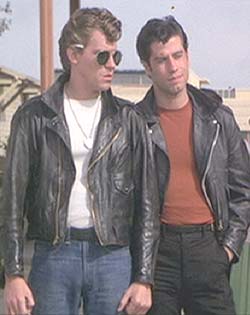
The article doesn't speculate about this profile beyond this assertion, but it is easy to imagine a "pack" of rough kids with an alpha leader and a cadre of betas and omegas. Being among the "in-group" of bullies requires adhering to a hierarchy. The one above steps on the one below, with the lowest order getting the worst of the abuse. Fictional examples of the bullied-bully are numerous. In Grease, Danny Zuko and Kenickie compete for the alpha-dog position within the T-birds. Danny is clearly alpha at the beginning of the story, but as he attempts to win the love of Sandy by trying out for the cross-country team (a violation of the anti-establishment posture of the T-birds), Kenickie seems ready to graduate from beta status at the moment of the big car race. A subsequent injury in Kenickie re-establishes Danny's position in the clique. Meanwhile, the three remaining T-Birds, Doodie, Sonny, and Putzie, remain un-reconstructed omegas through the duration of the story, paring up sexually only with their counterpart omega-femmes in The Pink Ladies.
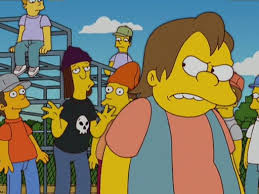
Similarly, in the animated world of The Simpsons, the alpha Nelson has, from time to time, crossed swords with Jimbo for control of the alpha position, while perennial omegas Kearney and Dolph must satisfy their angst by picking on the "nerds" of Springfield Elementary. Nelson is often seen keeping his "boys" in line with punches to the stomach and other acts of brutality. Acts which then filter down to the omegas and, eventually, into the society of victims ranging from Bart Simpson to Milhouse and beyond.
-
What do bullies do? Do they serve some sort of social function? Presumably, we'd all be a lot better off if we got along and were tolerant of each other. Maybe even the bully would agree, if he thought that "model" was a worthwhile one to follow. It seems that Nelson, et al have little faith in the "program." Already let down by parental units, given academic opportunities which he assumes set him up for failure, and then positioned within a hierarchy that rewards violence with respect (or fear), the bully settles into his role a kind of soft enforcer of social conservatism. The bully punishes the fat boy, the too effeminate kid, the “butch” girl, and the brainy “nerd,” all of whom are also loathed passively by the society at large. The bully concretizes this resentment with his jibes and his closed fists. We punish the bully, yet on some level must recognize that he is only manifesting the intolerance that becomes reflected in the culture through skinny teen models, uber-masculine “dudes,” endless heterosexual porn imagery, and a complacent culture of rampant anti-intellectualism.
The bully is society’s Mr. Hyde, its dark reflection. His pig-honesty sees the hypocrisy in our denunciations of him. His perpetual detentions and demerits only serve to underscore an ugly truth about society’s true feelings about itself.
I recently purchased a new mobile phone. A Blackberry Bold 9700. It is the first such purchase I have ever made. I am a very late comer to these devices. The past two models I’ve owned, a Verizon LG, and a Motorola of some sort (the latter being the epitome of compact design in my estimation) came with a packaged set up by my wife. Basically, the deals were pretty good so why not take a phone for emergencies? I have to confess, it only took being broken down and stranded on the 134 freeway at 10:30 at night to make you see the wisdom of owning a piece of cellular technology.
But recently I’ve noticed increasing number of my friends, colleagues and students have begun preferring text messages to email messages. Still other interlink their home and office email addresses with their mobile devices. Then there are the various functions that mimic or parallel the performance of a computer, such as accessing individual websites, purchasing good and services, getting directions. I realize these aspects of use are probably as interesting as oxygen to anyone under 30. Generation Y and their little brothers and sister in Generation Z increasingly disinterested in sequestering themselves in their rooms when they could be out in the world. But they still over their technology, just as their older cohorts and Gen X elders do. But the new wave of mobile technology allows them to seamlessly integrate their virtual lives with their flesh-and-bone lives.
And yes, the attention span does suffer. Focus erodes as capacity increases. It is also unclear how pervasive this trend is. As far as I know, no formal studies of youth behavior have been conducted to account for this almost absurd level of multi-tasking. I sincerely doubt there will be a dramatic decrease in the appeal of “cocooning” one’s self in his or her office and exploring the virtual space unselfconsciously. The youngest cohorts of Gen Y (approximately born around 2000 – 2001) will be entering their teen years shortly, whereas their oldest brothers and sisters are in their late 20s by this point. The middle cohort, hovering in sophomore and junior years of high school, are stuck between the coddling restrictions of the home-place, and the promise of adult freedom of movement. Mobile technology allows for a version of freedom that allows them to feel as if their world is much more expansive than it is. Meanwhile, tech-savvy Gen X parents feel the comfort of “sustained” contact with their children, even though they really can’t be sure if their kid is actually at their friend’s house, or visiting a tattoo parlor and making friends with a 25 year old named Hawk.
I don’t remember who said it… and I don’t even really remember the quote itself, but the gist was that Americans are never happier as when they are on their way to, or leaving from, someplace they want to be. In other words, we are restless. Mobile technology seems designed to placate, endorse, and facilitate this sensibility. The oafish call of “where you at?” is a code for the real question, “are you having a better time than I am?” The technology provides ample opportunities for “escaping” a less-than-desirable destination. How many women have extricated themselves from a bad date by feigning an important phone call? How many dull lectures have students avoided with the plausible excuse of a family emergency? The pantomime of sociability, trumped by the kabuki of far-off, personal matters.
Who will be the brave soul who call “Bullshit!” to this practice? He will be honored in Sweden, surely.
The long-term implications are impossible to presage, but certainly we will become more adventurous. We have mobility on so many fronts – from the personal vehicles we drive, to the tiny digital devices that allow us to be “stationless” – that we might well simply live totally on the lamb, as it were. We won’t live anywhere anymore, we will simply “crash” where we can. (There almost certainly an app for this for the iPhone.) Perhaps the unborn late cohort of Gen Z (eta, 2015) will grow up to become a vagabond middle class. Working itinerate service-sector jobs. They can do their work from the mobile command ports at Starbucks or Pink Berry. Their social lives will run the clock out. Although, by that point, we can expect neural interfaces to usher in the something like digital pseudo-telepathy. That would such a remarkable development that the paradigm shift that would be wrought can scarcely be imagined.
Meanwhile, in mid-2010, I am searching for a tiny SIM-card among the detritus of packaging material that came with my new Blackberry. It seems our shift away from paper has created a physical-world vacuum that will be filled, if not stuffed, with discrete pieces of clear plastic, and black twist-ties.
The following is a longer version of my Yelp review of Bob's Big Boy restaurant. A new location opened in my area.
For those of you unfamiliar with the chain, Bob's is a more-or-less typical middle of the road family dining establishment. The franchise has been around in one form or another since the late 1930s. It had its hey-day in the 60s and 70s as one of a dozen or so popular restaurants that appealed to the post-War generation of parents who, in possession of surplus income, found "eating out" to be a novel family entertainment.
Bob's was very appealing to children thanks to its rotund mascot, free comic books, and amble dessert options.
The chain went into decline in the late 80s and eventually declared bankruptcy. Subsequent revivals have seen an explosion of interest such that nearly 500 Big Boy's are now a going concern in North America.
In the following review, I refer to "The Fat Vegetarian." That is my moniker on Yelp. I write all my reviews from a vegetarian perspective. I try to locate vegetarian options at "regular" restaurants.
Pea-Soup Andersens meets Johnny Rockets?
The Fat Vegetarian hasn’t always been a vegetarian, but he’s always been fat. (Except for a brief but appreciated growth spurt in the mid-teen years that produced a rail-thin, Bowie-like vision that made him passable for leading a Roxy Music cover band… but I digress.) The fat begins and, evidently ends, with trips to Bob’s Big Boy, that bastion of family dining from the 1970s. Pappy Parker… Big Boy Combos… milk shakes… strawberry pie… and the infamous hot fudge cake, each were soldiers in the army that overthrew my will power for the better part of the Carter administration. (Equal blame can be laid at the feet of Sambo’s, Denny’s, Spire’s, The Park Pantry, The Parasol, JoJo’s, Norm’s, Alphy’s, and once a year, The Velvet Turtle… all those sundry middle-of-the road chains that sprouted up in suburbia between 1960 and 1980 that served predictable, inoffensive food to Boomers and their babies.) Bob’s was ubiquitous enough in the South Bay of Fat’s youth that you could drive from one location to the other and never have to turn left or right off of Hawthorne boulevard. They have always been an average, but enigmatic establishment. From the red relish to the near-perfect Thousand Island dressing, to the odd, pink glyco-gel they use to bind their strawberry pies, you were never unsure about where you were eating. The franchise, from what I can tell, has been through at least three revival attempts since the closures started in the 1980s. The “Hollywood hipster” revivals came in two phases in the 90s and seemed to coincide with the obnoxious Neo-Swing, doofus crowd converging at the Bob’s on Hollywood boulevard, and the old timey car crowd that, for whatever reason, associated Bob’s with car culture and nostalgia. But nostalgia is a poor business model. Just ask the owners of Ed Debevic’s. There has to be value and something you can’t get anywhere else. The reason Bob’s won’t die is because they use nostalgia to get old timers to visit, but they actually do provide a modestly interesting selection of unpretentious American food standards at a price comparable to the infinitely less interesting Denny’s or Carrows. (Has anyone ever desired their last meal to be catered by Carrows?)The newish location in Northridge (why is it listed as Chatsworth?) is immune to hip and keeps the kitsch to a minimum. It’s location predetermines it to be a utility player in the host of eateries up and down Corbin and Tampa. It’s traditional red and white color scheme partners it perfectly with its neighbor, Target, thus creating that all important “synergy” that businesses seek out. Load up at one, then load up at the other. The lack of hipness suggests that this location may be here to stay, and gauging by the packed house evidenced by a causal drive-by, it looks to have sparked the interest of the locals.
We went around 2:00 PM on a Thursday afternoon. There was plenty of seating.The interior is clean and bright, with lots of white surfaces and red vinyl seats . Chrome appointments accent the purposely-visible dessert station, thus providing the scene a hint of drive-in, “New Frontier” nostalgia without being pushy about it. The menus are falling apart… strange given how recently the joint opened.
From the vegetarian’s perspective, the Bob’s experience in general can be hit or miss. Not all carry veggie patties and most do not list them as an option on the menu. (Burbank being the notable exception.) And if they don’t have said-patties, the options are rather meager. Their grilled cheese sandwich is awful. The bread is never crisp and the cheese is skimpy. That being said, the Northridge location does offer the patty on request and is happy to put it on anything menu item you want. Because I was feeling jaunty I asked for a classic Big Boy combo with the veggie patty. I assumed the waitress would baulk at this idea as the classic Big Boy is a Big Mac-style burger… two patties. (When I have ordered a veggie burger at Burbank, they bring me a single-decker.) But she didn’t even blink, and a few minutes later, I had a double-decker with cheese with lightly cooked veggie and grain patties. Overcooking the veggie patty is usually a concern at restaurants, but here they were perfect. Also, the red relish was present and as tangy and tasty as I remember. I was charged extra for a second slice of cheese, which I thought was a bit cheap. Given the option of fries or onion rings I went with rings. They were fair. But frankly, the sandwich was a lot of food! This meant no room for dessert, but we did get a chance to watch many hot fudge sundaes and shakes being made. The staff looked to be very generous with the fudge sauce. Which is a positive sign.
Our waitress was very attentive. I asked for ice coffee (not on the menu) and she went to great lengths to make sure it was made the way I wanted it. She could have just said “no, we don’t do that” but she made a real effort, which is appreciated.
This Bob’s also has a modest salad bar that doubles as an all-you-can-eat breakfast buffet. Those options and the dessert intrigue made us curious to return. I suppose that is something nostalgia can’t provide... a future-tense of a place.
I started writing Mutable Gestures some years ago simply to doodle with ideas that struck my fancy. MG is a clearing house for writing that doesn't quite fit into my usual day-to-day writing concerns. A catch-all for the vagaries of my short attention span.
More recently, you may note that this space has been almost exclusively devoted to ruminations on the sport of mixed martial arts. This is quite a surprise to me personally for several reasons. I have never been a sports fan of any ilk. I also tend to loath most of the MMA fans I have had the misfortune to communicate with. Boorish oafs, meatheads, and spotty geeks for the most part. And the fighters themselves tend to be nearly as oafish and boorish, and very often come from a place of almost fanatical conservatism and religious zealotry.
The sport itself, the-fighters-as-fighters, and the fans-as-fans, represent a fascinating tripartite intersection of masculine fantasies, masochistic obsessions, and a level of commerce that blends true athleticism with pure spectacle.
Frankly, I can't get enough of it. And to witness a cultural phenomenon like MMA as it moves from awkward adolescence to plausible maturity is the proverbial once-in-a-lifetime opportunity. The narrative is compelling, the characters are intriguing, and the opportunities for deep analysis are inexhaustible.
So it seems I am hooked. I will be writing about MMA in this informal, digressive way (as befits the blog format) now and for the foreseeable future. For that reason I have started a new blog, simple titled The MMA Files. Mutable Gestures will continue to be a place of occasional writings and rants.
The fall-out from Fedor’s loss to Werdum has generated more interest than the fight itself.And while Dana White may rightfully gloat over the unqualified success of UFC 116, where his champion redeemed himselfby winninga fight that redeemed the UFC’s heavyweight division,he must also take more than a little delight in the problems that plague his competitor,Strikeforce president Scott Coker.Aside from the usual sanctioning complications and money hemorrhaging that new promotions experience, Strikeforce has problems unique to itself.Recently, the company brought MMA middleweight superstar Dan Henderson into the fold in order to remove their home-grown champion,Jake Shields, whose workman like performances and lack of celebrity appeal made him an untenable envoy for a promotion with mainstream ambitions. Shields ended up running through Henderson during their match and he retained his belt.Now he is, ironically, UFCbound, and Strikeforce is stuck with an expensive0 and 1 fighter and a vacant middleweightchampionship.
But it was the contracting of Fedor Emelianenko and his subsequent loss that has engendered so much speculation regarding Strikeforce’s plans for itself as a fledgling MMA promotion.The former long-time kick boxing promotion had a great deal of early success when began featuring MMA events in 2006.It set a box office record for an MMA in March of that year when it promoted the Frank Shamrock/Cesar Gracie match in San Jose, the promotion’s hometown. It was also the first MMA promotion to get the sport regulate in the state of California, thus opening a huge market for the sport.But this early success was not immediately followed up with.After the 18,000 – plus attendance of the Shamrock/Gracie card, subsequent events have struggled to approach the 10,000 mark.Buy-rates for PPV events were equally paltry.
One problem was the lack of named talent in the ranks.It is telling that one of the next major headlining event for Strikeforce after Shamrock/Gracie was a heavyweight match between early UFC chancer Tank Abbott, and journeyman Paul Buentello.(Buentello’s victory over Tank was essentially a “qualifier” for a shot at the then-non-existent Strikeforce heavyweight championship.) Another card with and aging and battered Shamrock as headliner against aging but viable kickboxing phenom Cung Le manage to pull a good gate.It was also the inaugural event for Strikeforce on premium cable, as the fights were broadcast live on Showtime. Nonetheless, the issue of depth-of-talent remained a concern.As the UFC witnessed stars, new and old, thriving in nearly every weight class- thus allowing fight makers more flexibility with creating plausiblemain-events,Strikeforce continued to struggle with its roster of aging stars and itinerate journeymen.
All young promotions go through a period of developing talent, especially as regards the heavyweight division.After all, the aforementioned Tank Abbott was a top contender in the early days of the UFC.The division is hard to keep stable because many fighters are physically better structured for light heavyweight.So you get fighters like Couture and Rashad Evans who can slip between the two.It is not surprising, therefore, that Strikeforce has had not really attracted a lot of big men.To this extent, I suppose one begrudge Strikeforce’s long-time,seldom defending champion, Alistair Overeem's desire to go abroad for several years and fightelsewhere.But once it had Fedor contracted,the question was how can Coker and company build a division that can rival what the UFC has to offer?Strikeforce had its own champion, a popular international star in Overeem.With some Stateside promotion, the good looking Dutchman could become a popular figure in the sport’s mainstream.With Fedor, the had the “uncrowned” king of all heavyweights.For however long he was under their auspices, Strikeforce could be an attractor of new heavyweight talent. They couldpotentially draw those big, young fighters away from Dana White and company.
The script, therefore, had Overeem returning from the road to defend his title against Brett Rogers and then, eventually, against Fedor.Fedor would probably beat Overeem, but win or lose, the fight had the potential of eclipsing anything Strikeforce had done in the past as far as attendance numbers and viewership were concerned. But for whatever reason, Strikeforce gave Fedor to Werdum, and with one tight triangle choke, made Strikeforce’s script moot.So what do you do if you are Mr. Scott Coker?What revision do you make the narrative?
First off,it should be understood that Stirkeforce does not care about concerns for "fairness" and title legitimacy.It wants legitimacy for itself as a promotion, which means it has to draw eyes first and foremost. Post-Fedor loss, the matchmaking scenarios it has in front of them are as follows:
Overeem/Werdum (for thebelt)
Fedor/Werdum II
Fedor/Antonio Silva (or possibly Ricco Rodriguez… or a similar non-UFC heavyweight)
Overeem/Fedor
Scenario #1 makes sense from a sport's philosophy point of view.Werdum beat the #1 contender.The champion should fight the #1 contender, right?Right, except that match will be a flop for Strikeforce.They haven't built Overeem as a brand.Also, casual and mainstream fans only recognize one heavyweight champion right now, and his name is Brock Lesnar. Names make matches. I don't think this match is really on Coker's radar at all right now.
Scenario #2 has the ethos of "the rematch" and might do as well or slightly better than the first fight.Winner get's Overeem.A good option would be to have Overeem defend his belt against Silva.“Bigfoot” has experienced some laudable wins in the past several years, including a dominating performance over Andrei Arlovski in May.Silva was a nominal world champion, briefly,for EliteXC,the company from which Strikeforce salvaged many fighters.So there is some symmetry there.
For many of the same reasons,Coker could opt for scenario #3 and have Fedor face Silva, the only other plausible heavyweight competition in the promotion. Such an arraignment might make Overeem/Werdum viable as a co-main event.That way, both winners would be on pace to meet each other in four-month’s time (providing neither is injured).Ricco Rodriguez comes up as a possible candidate as both he and Overeem were to meet ostensibly for a match in Japan’s DREAM promotion.The lack of a contract may make the former UFC champion attractive to Strikeforce.But there are dozens of unaligned heavyweights “out there” waiting to be signed, and it may not make much difference to Coker who Fedor faces as long as theirnamesaren’t Arlovski or Rogers.Who’s to say that Coker isn’t also considering Kimbo Slice as a possible acquisition?A Fedor/Kimbo headlining card would certainly draw eyes… as well as derisive howls of ridicule.
I think scenario #4, Fedor versus Overeem for the title, is the only match that guarantees Coker two good-to-excellent outcomes.A win for Fedor – who would still be the likely favorite -would give any rematch with Werdum much stronger gravitas.Fedor would be seeking redemption.Werdum would get his title shot as well as a chance to confirm that his first win wasn’t a fluke.It is would make for great drama and easy promotion.
While all this is going on,Strikeforce’s legal department is working on getting new verbiage into fight contracts that requires a champion to stay in the promotion as long as he is in possession of the promotion’s title.Coker must know, however, that Fedor as champion is untenable for the long haul.He will defend it to beat Werdum, buthe isn’t going to stick around and fight… who?Rogers again?Overeem again?Silva?Even if the strategy works and Strikeforce begins to blossom and attract talent,there wouldsimply notbe enough time to arrange and promote an outsider for Fedor to fight.The division wouldbe developing,but far from developed.
What needs to be understood at this point in the story is that the ultimate destination for Fedor in the twilight of his career is the UFC.Two dominating wins and a division championship is probably exactly what it isgoing to take for Dana White to get back in the business of Fedor Emelianenko.Of course, now Zuffa’s hand will be much stronger, and M-1’s much more compromised.Fedor will come to the UFC, but he will come as a fighter, not as an enigma.
Coker must foresee thisoutcome, too.He can sue Fedor for breach of contract, sure.But Zuffa’s legal team is sure to make this case drip like cold sap through the legal system.There may be a payoff at some point,and Strikeforce may win, but by that point,Fedor will have appeared on The Ultimate Fighter, won thebelt at a massive out-door main event, and made the White et al millions.
So why not make hay while the sun shines?Or in this case, while the “Russian Tsar” shines?If hecan pull off a duo of Fedor cards before the big man bolts,Coker might just have… well, what will he be left with?Two good gates?Decent ratings?But no star.No dream matches.And this gets to the heart of the real dilemma for Scott Coker:without a solid, loyal fanbase, without regular, weekly TV exposure, and without a stableof viable and attractive fighters, it doesn’t matter what direction you send Fedor.He is one fighter with his own destiny.Strikeforce is a business with a future that must be project far past the exigencies ofsingle fighter, a single match, or a single season of cards.
Seldom is history ever really made in the world of mixed martial arts. It is a new sport. It has a growing fan base. The competitors tend to come and go. Careers are brutal and very few get to perch on the narrow summit of glory and gold. But Fedor Emelianenko is one of the sport’s legitimate international success stories. He’s been there, he has won the championships, and he has made his money. Fedor has been the #1 heavyweight in the world for nearly a decade, and in the top five of the pound-for-pound standings for nearly as long. But what made Fedor the most talked about man in MMA for all these years is one quality that no other fighter could boast as possessing… an undefeated record. With the exception of technical loss due to doctor’s stoppage of a tournament match, Fedor had never lost in 34 matches. That fact alone was his most compelling argument. It was his management team’s leverage. It was his mystique. His calling card and in many ways, his greatest weapon. It created an aura of invincibility and a level of intimidation that no amount of training could every replicate. That aura vanished on the night of the Saturday June 26th in San Jose, California as “The Last Czar” was submitted by fellow ring veteran, Fabcricio Werdum in under two minutes of the first round. Fedor came at Werdum with a flurry of wild, looping punches. The salvo sent the Brazilian to the mat and it looked like a quick KO was in the offing for Fedor. But Werdum, a black belt in BJJ, kept catching Fedor’s arms before they could land cleanly. And in the spirit of Beckett’s maxim “try/fail/try again/fail better” Werdum persisted with grappling until he had Fedor’s head in a tight triangle lock. Werdum had two advantages at this point in the match. One, it was early in the round so the fighter’s bodies were still relatively dry. As matches progress, BJJ holds become increasingly difficult to hold onto. But Werdum and Fedor had not started to perspire, thus the lock had friction to help it “stick.” Second, Werdum is 6’4” with perhaps 40% of that height being in his long legs. Leg-length means more leverage and a “deeper” cinch. Triangle chokes in general favor long legs. Once sunk, they are nearly impossible to escape. The hold also leaves an arm vulnerable, and the head exposed for striking. In other words, properly applied, it is pretty much the worst hold to find yourself in. There is no real “answer” to the hold unless you can create space in the cinch to allow a modicum of blood to continue to flow to the head. Travis Lutter had some success with this defense when he met Anderson Silva. Silva had the triangle totally locked but Lutter was able to work his hand in enough to keep from being choked out. Of course, Silva still had a clear shot at Lutter’s skull, and promptly began bludgeoning him with elbows. The point it, Fedor found himself in the worst possible hold for him, at the worst possible time. There was really no chance for escape and the bell would not rescue him. The single tap from Fedor on Werdum’s thigh was a gesture made, not so much out of desperation as resignation.
Implications:
1. Win re-legitimizes Brazilian Jujitsu as strong finishing discipline: The UFC’s emergence as the major league mixed-martial arts promotion has brought with it a host of unintended consequences. Among other things, its acceptance by the American mainstream has meant that fighters tend to want to “end big,” which usually means instigating a striking war. Grappling, once the co-equal partner in the MMA game along with striking, has taken a backseat to flashy, “highlight reel” knockouts. The UFC even has a multi-volume DVD compilation called Ultimate Knockouts. (An Ultimate Submissions compilation was released in 2003, but it has since gone out of print.) It is perhaps an American bias, but if MMA is to truly take root as a wholly-integrated combat sport, rather than a sloppy punch fest, it will need to hold on to its roots. Fedor’s submission at the hands (and legs) of Werdum should go a long way towards reminding fans of the deadly potency of BJJ. The sub should sit alongside Frank Mir’s ankle-lock win over Brock Lesnar, BJ Penn’s gory rear-naked choke of Joe Stevens, and Ryo Chonan’s flying scissor lock submission of Anderson Silva as examples of how exciting submission grappling can be.
2. Loss suggest massive hole in Fedor’s game: Fedor’s long winning streak has essentially been against two types of fighters: wrestlers and kickboxers. The last time he fought an elite, black belt in BJJ was 2004 when fought two grueling matches against a young Rodrigo Nogueira. Prior to those encounters, one was to return to 2003 and “Big Nog” again to see Fedor against a BJJ artist. Further back, and it’s not until 2001, very early in Fedor’s career, that he meets Renato Sobral, another BJJ artist. Finally, in 2000 and Fedor’s forth match as a professional, he met Ricardo Arona. All of those matches went the distance. Fedor picked up wins in all but the single no-contest against “Big Nog.” It is only after the loss to Werdum that we can look back and note how strange it is that an elite fighter could compete for over ten years and only meet four BJJ black belts. Fedor, himself a black belt in judo and a decorated samboiste would seem a natural to fight the legitimate heirs to the judo tradition as represented by the discipline of BJJ. But he simply hasn’t. Was this by design or simple matter of scheduling? Surely Fedor knew Werdum’s pedigree. Perhaps he and his camp read his getting cut from the UFC as evidence of Werdum being in the nadir of his career and therefore an easy entrée before the inevitable and long-overdue title shot against Overeem. Whatever the case, the loss will force Fedor to do something that he has never done before: re-evaluate his game. Indeed, Fedor seems to have already diagnosed his problem. Minutes after the loss, in his in-ring interview, Fedor knew he had over-committed to striking Werdum on the ground without taking his position into consideration. He essentially assumed he could bludgeon his way through Werdum’s guard and break through whatever hold he was contemplating. It is unlikely he would make such a mistake in the future. But once was enough.
3. Loss may help get Fedor into the UFC: It is no mystery that Dana White has been campaigning to bring the big Russian into the Zuffa fold for years. The acquisition of PRIDE by the UFC seemed a bellwether for a mass exodus of talent from that withering promotion. Many came, but Fedor stayed aloof. Negotiations stalled. Both sides blamed the other for intransigence. While it is possible that White, et al, may not have given Fedor and his management team the degree of deference they may have felt they had coming to them, what has surfaced over the months and years of failed talks is the rather untenable scope of the Russian’s side’s demands. For the privilege of bringing Fedor to the UFC, Zuffa must allow him to continue to compete in amateur sambo events. In other words, UFC would release their potential head-liner and world champion to fight in another combat sport where he could possible get injured. In addition, the UFC would have to give contracts for members of Fedor’s fighting club. That’s right, along with the great Fedor, the world would get to witness the likes of Lassick Shibanov, Dzhamal Kubanov, and the great Maxim Grishin. (I should add that not all the members of the club are regional yokels. Light heavyweigh standout and multi-promotion world champon, Gegard Mousasi also fights under that banner.) And finally, and perhaps the tipping-point for the Zuffa side, all Fedor bouts would have to be co-promoted with M-1 Global, a small promotion out of Holland, co-owned by Fedor. Naturally, the UFC has no interest in diluting its brand after spending nearly two decades establishing it just to get a single fighter under its banner. The enigma of Fedor’s place in the world of MMA, however, meant that the pressure to get Fedor would remain, regardless of who else fought in the heavyweight ranks of the UFC, and no matter how much Dana White railed against the consensus of Fedor as the best pound-for-pound fighter in the world. But now that enigma has been compromised it is possible that much of M-1’s leverage has eroded as well. They can no longer pitch Fedor as the invincible monolith. He was beaten soundly in under 90 seconds by a fighter who had been cut from the UFC after a devastating first-round loss of his own. This, combined with the legitimate (and now some would say confirmed) criticisms of Fedor’s lack of real competition since 2005, and the reality that Fedor is only getting older, more injured, and slower conspires to weaken Fedor’s negotiating hand. It is now doubtful whether he will ever gain mainstream acceptance as one of the greatest fighters of all time unless he competes and dominates the UFC heavyweight ranks. Honestly, it is likely that he would dominate Lesnar, Mir, and Carwin, if he were to sign with the promotion in the next 18 months. Indeed, he would be favored to win the title, recent loss or not. But the ranks of the division are growing exponentially and the younger talent are looking very impressive indeed. If he were to take a contract with the UFC, it is equally likely that he’d receive his second legitimate loss. So, the clock is ticking in more ways than one. The Werdum loss may expedite something that many saw as inevitable years ago.
UPDATE: On July 1, Dana White verbally closed the door to the notion of Fedor coming to the UFC in an interview with ESPN radio, suggesting that there was no longer any incentive to sign the Russian after his loss to Werdum. The consensus among MMA pundits and prognosticators is that White is essentially entering into a kind of pre-negotiating stance, anticipating a humbled, hat-in-hand gesture from M-1. Where once Fedor’s management believed they held all the cards, the combination of the Werdum loss and the poor ratings and gate of both the Fedor-fronted Strikeforce events (not to mention the disastrous PPV numbers for the PRIDE event in Las Vegas of 2006), would make it laughable for them to reiterate the same contract demands of previous years. For his part, White would be ill-advised to write off Fedor’s marketability. The UFC greatest asset is its ability to promote itself and its fighters. They could supply the missing piece to Fedor’s legacy, which is mainstream recognition, and pull off the biggest card of its history. One can imagine a July 4th weekend card… perhaps in 2011 or 2012… that sees Fedor fighting for (or defending) the belt against a big American opponent. Lesnar… Carwin… even Randy Couture, the dream match of the ages… red, white, and blue American flags, blue, white, and red Russian flags. Surely White has this image in his head as well. The hard talk is just that, talk. One must remember White’s other “absolutist” statements regarding such matters as Liddell’s retirement after the Rua knockout, and the “Kimbo sucks” comments that eventually led to the big street fighter headlining The Ultimate Fighter in 2008.
4. Outcome bungles the script for Strikeforce: The plan was to go something like this: Spend the money, bring Fedor into the fold after the UFC balks. Fedor being the biggest name in MMA (at least according to the hype) would help the upstart MMA promotion compete with the UFC for a national audience . Mix network exposure with a heavily promoted premium cable events to get the names out there. Give Fedor a couple of “gimmie” matches. Collect your home-grown heavyweight champion from his globe-trotting. Bring him to the States so he can defend the belt for the first time. After both the champion and Fedor clear out the paltry stable of contenders, start building to a signature event where the two meet. Sure, you took massive losses on the build-up events in 2009 and 2010, but surely Overeem/Fedor would be your promotion’s payday, right? Overnight you would become Burger King to the UFC’s McDonald’s. It was all going to plan. Fedor came and destroyed Brett Rogers. Mr. Rogers then provided Alistair Overeem with his soft defense. No one really watched these bouts, mind you. The ratings were modest to say the least. But what was important was to show that Strikeforce could put on world-class events… even if they had to recycle bodies. Curiously, the match that most would assume would be forthcoming, Overeem/Fedor, was not in the offing. Timing meant that Fedor would fight once more before “The Big One.” No bother. Here’s another body. Here’s Fabricio Werdum. A ring veteran who had just been cut from the UFC. Naturally, Fedor would walk through him, right?
Not so fast, comrade, says the ghost of Helio Gracie from BJJ Valhalla.
Naturally, we were all surprised. So if you’re Strikeforce, what do you do? Do you give Werdum his title shot? To give Fedor a rematch? Do you say “screw it” and give Fedor a title shot anyway? Obviously, Strikeforce doesn’t care about little things like legitimate contention. Overeem won his belt from a 25 and 10 journeyman and the vanished off the scene for three years. Brett Rogers was rewarded for his loss to Fedor with a title shot. (Who else were they going to give it to other than Fedor? Tank Abbott?) Overeem may simmer for another season, waiting for the outcome of Fedor/Werdum 2 because what is important to Strikeforce is creating that BIG payday; that singular event that will carry them over into legitimate competitiveness with the UFC. But even after Saturday’s historic bout, it is doubtful whether many American fans are any more familiar with the name “Fedor” than they were on Friday. And if that’s the case, Strikeforce, the brand, certainly can’t piggy-back off that lack of impact. It can’t build from the assumption that they have a star on their hands. A win for Fedor would have deepened the mystique and enlarged the enigma, but it may not have done much beyond that in the eyes of the casual MMA fans, who, after all, repesent where the real money is.
5. Outcome may cement Brock Lesnar as #1 heavyweight in world (proving he beats Carwin): If nothing else, Fedor’s loss to Werdum will mean that the Russian will likely fall out of the Top 10 overall rankings. Having not won a major promotion title since PRIDE’s closure, Fedor has been the “uncrowned champion” exclusively by virtue of his winning streak. (He does hold a nominal world title under the all-but-defunct World Alliance of Mixed Martial Arts sanctioning body, but he is rarely advertised as thus.) Given the dearth of legitimate heavyweight contenders in the MMA in general, the question remains who, if anyone, will take the place of Fedor as the world’s number one heavyweight? There are not a lot of names to choose from. Like the middleweight division (specifically in the UFC) the heavyweight division has had a hard time securing consistent talent. The 265 pound cut-off point for the UFC means that so-called super-heavyweights need not apply, and many fighters have traditionally hovered around the low-end of the scale nearer 205. Thus, viewers have witnessed popular fighters (Randy Couture, Rashad Evans) dropping down to the pack the light-heavyweight division over the years; often leaving the title belt in the hands of less elite, but more legitimately “heavy” fighters like Tim Sylvia and Ricco Rodriguez. (Which, in turn meant that the heavyweight champions would often fight “contenders” like Justin Eilers and Gan Mcgee.) But the scene does seem to be changing, and not just in the UFC. While the Zuffa-owned promotion has grown the division in the past year with heavy promotion of the weight class through their flag-ship program The Ultimate Fighter, the rank-and-file also consists of new talent drawn from more conventional recruiting streams. The new pool consists of “legit” heavies like Cain Velasquez, Junior Dos Santos, and of course Shane Carwin. Meanwhile, long time heavyweight competitor and former champion, Frank Mir, recently bulked-up in preparation for his bout against Carwin (which he evidently assumed was a warm-up for Lesnar, given how devastatingly he lost) suggests that fighters in this division have to make a difficult choice to either bulk up or cut and be large sub-205 competitors. And indeed, Mir has recently contemplated a move down to that division. Regardless of who wins on July 3, the bout cements the new direction of the UFC’s heavyweight division. It will mean smaller heavyweights (those who are 220 and lighter) will struggle to compete against these highly athletic and almost inhumanly powerful men. The division will then become singular and possibly exclusive. Providing the UFC can continue to attract (literally) big talent, it may further affirm the promotion’s dominance in the sport. For his part, Fedor may or may not be able to sustain a consistent winning record in the super-sized heavyweight division of the UFC. Even during his undisputed years of dominance from 2000 to 2005, he seldom fought big heavyweights. When he did fight monsters, they have often been of the “freak show” variety, such as Zuluhinio and Hong Man Choi. Hardly elite fighters. He may find himself staring across the ring at other PRIDE alumni like Mirko CroCop and “Big Nog” Nogueira, lighter heavyweights who haven’t quite found breakthrough success in their new home.
6. Loss may send Fedor into retirement: Aging, active, and often injured. This has been Fedor’s life since 2005. Broken hands, injured ankles, and the multiple lacerations are the hallmark of someone who has been in the fight game for over a decade. To be sure, the competition prior to coming to Strikeforce has been prescribed to present Fedor with plausible competition, but without over-taxing his skills. His first fight in Strikeforce against Brett Rogers, though still quick work for the Russian, did bloody Fedor’s face more than he has been in recent memory. The catastrophic, even rookie-level mistake made during the Werdum fight further suggests a dwindling of his powers. A retirement bid at this point might prudent, but it also may be premature. If Fedor can mount a training camp that significantly improves his already formidable skill set, he could legitimately make a run at the UFC belt. We need to keep in mind that the Werdum submission was an error, not an existential fault, like Chuck Liddell softened chin of recent years. And speaking of knock-outs, it should also be noted that Fedor has never been knocked out. The current crop of UFC heavyweights (with the exception of Mir) are not submission specialists. It stands to reason that Fedor would have more than a mere puncher’s chance against Lesnar or Carwin. So while it is true that that he may be nearer the end of this career than the middle, a retirement path would be better plotted out in years rather than months.